
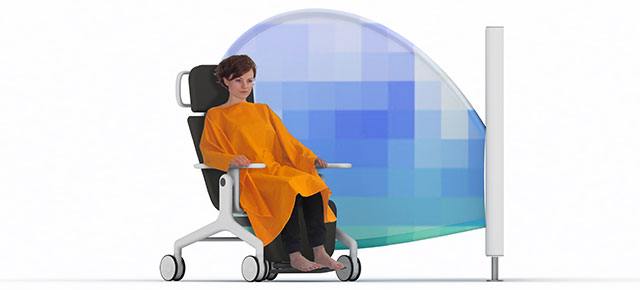

Last week I interviewed Tom Lloyd about the NHS / Design Council open initiative ‘Design for Patient Dignity’ that PearsonLloyd have contributed to. I am a huge advocate of design that makes people’s lives better – and one of the times we feel at our most vulnerable is when we’re in hospital, so I was keen to find out more…
“Our brief was mobility,” said Tom, “so we were looking at ways to give patients more dignity when they were moving around spaces within the hospital. The first thing we identified was that you are either moved in a portering chair [similar to a wheel chair] or you go into a bed. You’re often too ill to be in a chair, but not ill enough to be in a bed.”

“You could be being taken to x-ray or having blood tests, so it often involves some waiting. You might end up waiting in a bed, which from the hospital’s perspective isn’t a good use of space, and from the patient’s perspective can make you feel quite vulnerable. There’s a lot of research around this – you can’t get eye contact with the staff, you see people brushing past and you can’t really take in what’s going on, and you would never normally be in bed in a public environment, so emotionally, it can just make you feel quite vulnerable.”

“At the same time there is increasingly a strategy for in-chair care. A lot of treatment can now be done in chairs, such as out-patient chemotherapy, dialysis, or even just being given some painkillers and a bit of time to recover from a minor episode. You don’t necessarily need to be in a bed. On the other hand, if you’re in a chair and you’re about to faint, or you’re waiting for a while so you want to sleep, that doesn’t work either.”

“The Day Chair is a hybrid, so you can be put in a neutral position, where you’re not going to fall out, and you can sleep – so you’re in some form of safe space. The ergonomics of the form was inspired by our work with airlines and the zero gravity ‘S’ position, which puts the least possible amount of stress on the body,” said Tom.

“The Bay Screen was developed because people don’t like being put into a room when they’re being cared for. They worry they’ll be forgotten, but on the other hand they often need some privacy, depending on the conversations or the treatment that is happening. So we created a herringbone layout, where, just because of the layout, you can’t get eye contact with any other patients, but you can see the medical staff and they can see you. It allows you to communicate with the staff, so you don’t feel forgotten. It’s really simple. The design of the screen was just to add a bit of colour.”

“As part of this project, fashion designer Ben de Lisi was working on an alternative to the gown, so your arse doesn’t show when you’re taken to x-ray!,” said Tom. “The poncho we designed is just to pop over the top of a gown, or your own pyjamas, for moving around the hospital. It’s easy to get on and off, even in a chair, and the lack of a sleeve enables access to a drip. We did a variety of options in terms of colour and pattern – we were looking for a way to add a bit of colour, and create something a bit less technical and institutional.”

“Sadly, none of this has got to market yet – the chair is probably the most likely to. We’ve had interest, so we will take it further. The way these projects work is that the IP stays with us. You’re trying to make observations that are appropriate, where you can make a difference at a reasonable cost, so hopefully something will come of it.”
Further reading for the especially geeky:


Thank you for thinking so brilliantly in this realm. I am a professional health care fundraiser. I have often wished that we had private “halls” that only patients/families and health care professionals could access, to avoid transporting exposing patients to public areas.
I love your designs. Would hope they could be used in healthcare clinics/hospitals everywhere.