
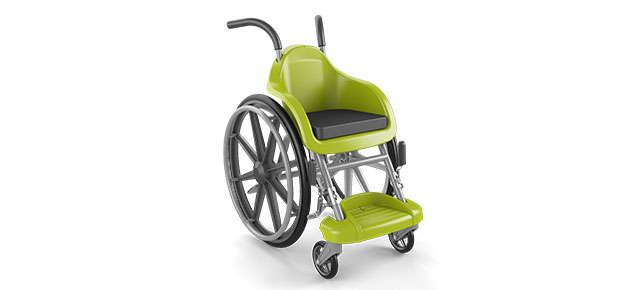

I spotted this wheelchair at the Designs of the Year exhibition at the Design Museum and was intrigued to find out more. It is the first children’s wheelchair to be designed specifically for children, rather than being just a scaled down version of an adult wheelchair. Its design was inspired by seats on theme park rides and it was tested with real patients from the very first 3D printed prototype. “It was very emotional for us because when the children were moved from a traditional chair to ours, they didn’t want to give it back,” says Pablo Kaplan, co-creator of the project, who wanted to use his expertise to give something back having spent 30 years in the plastics industry.

The final resin product is low cost enough to achieve wider distribution than traditional wheelchairs. 20 million people requiring a wheelchair for mobility do not have access to one – 25{ff546b69e23b1524d799f96c6ba7a638e1f677053b0a2a1568b05315fd5f8fc7} of those people are children in developing nations, most of whom are excluded from formal education as a result. “The wheelchair provides mobility,” says Kaplan. “Mobility provides access to education, empowerment and independence. This is the core of our project.”
Wheelchairs of Hope from WOH on Vimeo.
Further reading for the especially geeky:
- design for good :: patient dignity
- design for good :: a better a&e
- design for good :: a litre of light
- design for good :: gert




It’s fine, unless the child is actually disabled and needs therapeutic seating and positioning.
Plastic will mean pressure sores but it’s a great start.
An excellent idea. With 3D printing, the seat can be tailored to fit the individual child’s needs. This is much better than a “one size/shape fits all” design based on the current range.