

In this week’s column, Fixperts Resident Maya Alvarado shares a day in her week working with British furniture manufacturer Benchmark looking for ‘fixes’ in their workshop and in the local community – this week she starts work on doors to prevent dust gathering on the workshop’s sample shelves and makes her first prototype for a dinner tray for local resident Mrs Ellis.
06:45: I wake up, take a shower and eat breakfast.
07:40: Now that the clocks have gone back the mornings are lovely and light. On route I see that the green leaves have turned to a mixed palette of yellow-green, orange and brown.
08:30: To prevent dust from collecting on the samples shelves in the spray room, I make some doors to cover them. Originally I was going to use Perspex, but there is only cloudy, so I go for an MDF (medium-density fibreboard) panel. Kenny in the workshop shows me a really good method of making the doors. I cut the frame of the door and together we route (cut with a router hand tool) a groove where the thinner panel will sit – this helps to make the door a bit lighter. Then we domino (placing little flat pegs in grooves) together each part of the frame with the panel locked inside. I have never used overlay hinges before and Kenny shows me the drill that is set up to cut holes that will accept the hinges.

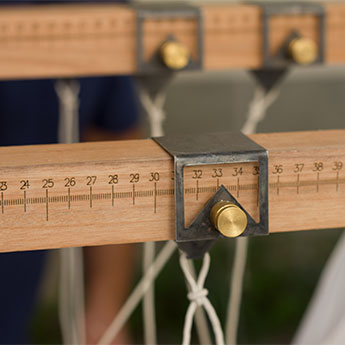
11:45: I walk over to Mrs Ellis’ house in the village to test an early prototype of her food tray and to take some more measurements. The prototype is okay dimensions-wise, but the rectangular corners prevent the tray fitting inside the frame of the walker. The next test will need to have the corners removed. We measure the optimum eating height for Mrs Ellis to be 85 millimetres below the top bar of her walker.

12:30: We share a delicious lunch of salmon and green vegetable pasta cooked by Mireya. I watch how Mrs Ellis uses a wooden placemat as a surface. It is a little low and does not provide a completely level surface. Mireya comments that the food sometimes slips and could be dangerous. I note that the tray must be fixed in a sturdy horizontal position. Mrs Ellis’ son is visiting from New Zealand this week, so she asks me if it is okay to resume the project afterwards. I will continue to work on the prototypes, which provide a safe, and comfortable eating surface and ideas for manufacture, ready to test with her in a few weeks.

13:30: As I return to Benchmark I develop the sketches of the food tray with the new measurements. I consider curving the edges to mimic the lip on the existing plastic tray. Mrs Ellis has specified that she loves having all of her daily possessions contained nearby in the same way as they are stored at the moment. I want to ensure that this detail remains in the new design.


16:00: Taking into consideration the points Mrs Ellis raised, I create a second prototype of the food tray. This is a very crude model, purely to test dimensions and overall structure. It does not yet include the ergonomic and useful curves to protect stored items. The back corners are shaped to fit inside the bars of the walker frame, a box below holds the tray at the Mrs Ellis’ optimum height for eating and the tray extends outwards to create a table surface. The whole assembled item is quite heavy, so I want to reduce the weight. It must be light enough for Mrs Ellis to push when walking, and for Mireya to lift during cleaning. I speak to Pete in the workshop about alternative methods, as it is not possible to injection mould a light plastic form. He suggests forming layers of veneer to build up a strong tray in the bag press (a large plastic bag attached to a vacuum which compresses everything inside together). Being both the Fixpert and the filmmaker at this stage, I realise how good it would be to collaborate with filmmakers for this project. It would change the documentation of the interview and prototyping process, allowing a collection of more varied shots whilst I’m interacting with the Fixpartner.

18:00: I head home – it is so dark out here without London’s light pollution!