
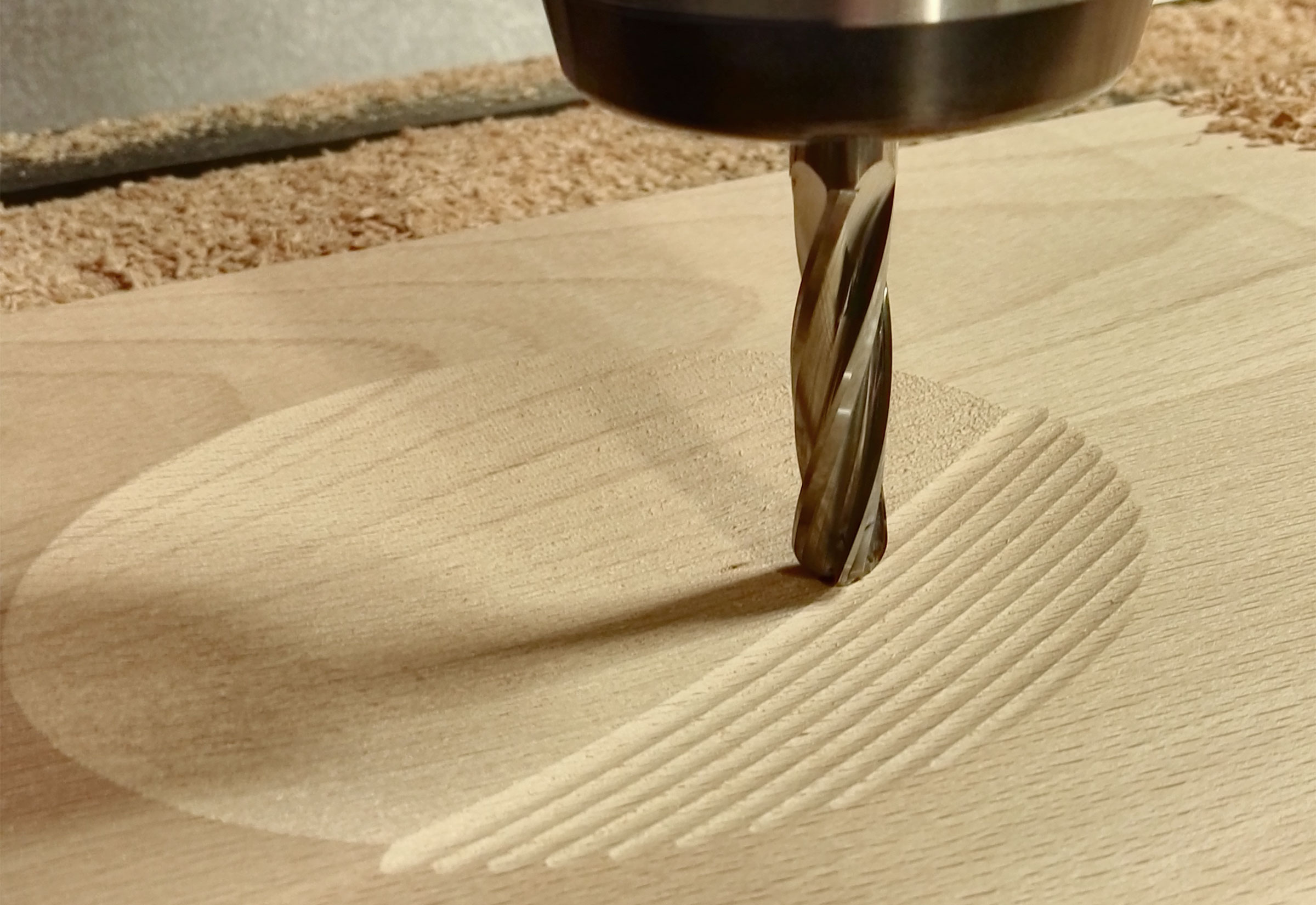

Norwegian designer Sverre Uhnger launched Trace, a collection of wooden platters, as part of Structure, a showcase of contemporary Norwegian craft and design in Milan’s Ventura Lambrate. confessions of a design geek editor Katie Treggiden was intrigued by the juxtaposition of craft and modern technology in his collection, and caught up with him in Milan to find out more…
What’s the most important thing to know about you?
That’s a good question and difficult to answer. Maybe that I am a nice guy? I am passionate about what I do and I describe my work as focusing on creating products that feel natural to the user and where the inherent qualities of the materials and the production techniques are emphasised.

Where do ideas come from?
It is never the same. I work in two ways; one is on briefs from manufacturers and the other is my own ideas that I develop and showcase at fairs and design weeks. When I work on briefs there are often specific uses, manufacturing techniques and materials that I have to work with. Often the brand or manufacturer has a brand identity or visual direction that also has to be taken into account. As a designer it is often good to have limitation in the creative work, as design literally means ‘solving problems’. When I self-initiate projects I can do whatever I want. I have done a lot of projects in wood since I have a background as a cabinet maker and craftsman. Knowing a material that well makes me able to utilise the material properties actively in the design. I try to vary the size, function and materials used in my self initiated projects to show a broader spectrum of my work.

The latest example of this is the project I am showing at Wanted Design Manhattan this week in New York. It is called Fold [above] and is my first project in mouth-blown glass done in collaboration with Magnor Glassverk and their experienced glass blowers. It is not finished objects but an ongoing study and exploration of the properties and feel of glass as a material. I am showing two sizes which is an attempt to catch the feel of hot glass and create a shape that is soft and inviting.

What was the inspiration behind Trace, the wooden platters you showed at Structure in Milan [above]?
The concept was initiated by discussions with the stylist Kirsten Visdal and fellow designer Runa Klock about the traditional Norwegian decoration of wooden objects such as kitchen utensils and storage for food – and how ornamentation has been looked down upon in Scandinavian design for a long time. Trace came out of this discussion and a desire to create ornamentation with a purpose.

Tell me about the merging of CNC [computer numerically controlled] technology and the ‘mark of the maker’ in its manufacture.
Trace represents an attempt to create digitally manufactured wooden objects that still carry the signature of the process that created them. Whereas handmade wooden items such as bowls or ladles might carry knife marks or cuts, products made using computer-controlled machinery typically have the grooves and imprints left by the CNC mill sanded away. This collection of trays and platters preserves these ‘traces’ as a form of ornamentation, allowing the user to gain an insight into the story of an object’s production, and glimpse how the machine used has ‘revealed’ the piece from a single wooden block.
What is your favourite tool?
Discussions. And callipers.

Tell me about a good day in the life of Sverre Uhnger and a bad day.
I work long days and usually rate the day by how I feel when I get home. I can get home just before midnight totally exhausted but with a great feeling because I have had some good meetings and got a lot of work done. A bad day on the other hand can come from doing office work all day and not getting time for any creative or practical work.
What defines good design?
If you go back to the definition of design then the answer has to be a product or service that solves a problem and does what it is supposed to do. In that way good design is very focused on function. Personally I can add that an object can be great because it is beautiful, but does not have a specific use or function. It can add value to the owner or to a room or setting. Design as a term is washed out and means different things to different people. But as a rule I think well designed objects are easy to spot and even though I may not have the same aesthetic preferences as the person who made it I can still enjoy an object where everything about it has been analysed, worked on and is there for a reason.

What are you most proud of?
Recently it has to be the Wallpaper*Handmade project [above] because of its complexity and the possibility of working with technical glass. But in general I am proud of being where I am today – I really enjoy the part of running a studio that is creating projects and opportunities. I am also very proud of initiating Klubben a few years back and all the good ripples that idea has had for the designers involved and the Norwegian design scene more broadly.

What advice would you give to an aspiring designer?
If you want to start your own studio go for it – but prepare well! That could be getting some work experience in an established design studio, taking a crash course in economics, business or accounting, asking around about standard contracts and fees and last but not least; make sure you have an income – whether that’s a client that you will work with long term or a part-time job alongside your studio work.
And finally, what’s your favourite colour?!
He he, this changes all the time actually! If you asked me this question when I was a child the answer would definitely be green. In my latest project Fold for example (which is my first mouth-blown project) I have worked with different shades of red which stand really well together with wooden objects on a table or shelf. In general I tend to like colours that are a bit off or tweaked, that being more black in the mix or faded.

Further reading for the especially geeky:
- interview :: made by michael
- interview :: nordvink
- interview :: james molkenthin
- interview :: juliette bigley


It’s very inspiring reading the story behind the work and I love the mix of wood and glass that Sverre Uhnger is using. Looking forward to read more stories like this.