
The London Design Festival is a kaleidoscope of visual stimulation – you will never see so much design in one place at one time. You rush around from one thing to the next wondering how on earth you’ll squeeze it all in, trying to see as much as you possibly can in the time you have available. It’s incredible, it’s inspiring, it’s fast, it’s slightly overwhelming. So to find something that makes you stop,
look,
and breathe…
is a rare and special thing indeed.
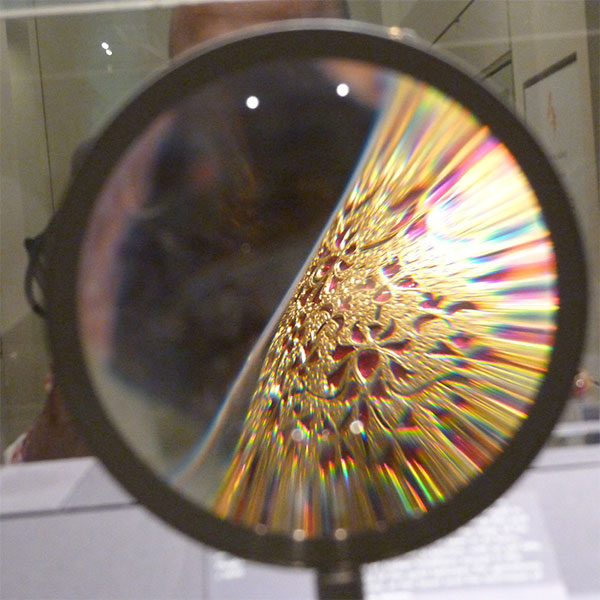
In partnership with Swarovski, the London Design Festival commissioned 14 designers to each find a tiny detail within the V&A and highlight it using a Swarovski lens. I’m not going to take you on a whirlwind tour of all 14, because that would defeat the object, I’m just going to show you one… Ross Lovegrove chose a golden spoon made in 1600 for Mughal emperor Ali Akbar and his explanation of why was the quiet inspirational moment that made my day…
He said: “You can just wonder in off the street and come into the V&A – my studio is very close so I often do. There are moments when you just need to see something amazing. When you come here you see such immense sophistication. I have easily chosen ten things – there’s a Celtic doorway just around the corner that’s incredible – it looks like it was digitally designed… but if you want to focus in on something using a crystal, I think its better to choose something small – plus my eyes are going a little bit, so although I love that spoon, I do need the lens to see it properly!”
“When you walk around a museum, no-one’s giving you a focus, no-one’s saying look at this or look at that, and that’s a beautiful aspect of this project. To have people who live in London and do interesting things saying to people: “Gosh take a look at that!” I love that idea.”

“The spoon does stand out. If you look at everything in the cabinet, it’s all remarkable, but the spoon itself – what shocked me is its complexity. As designers, we are visually led – our eyes do all the work initially, so we are seduced by something we’ve never seen before and we’re seduced by complexity. I think complexity is a beautiful thing. I don’t like to undermine or underestimate the human capacity to love and enjoy complexity. In an age where design is being simplified – and there are reasons for that and I love that too – to come here and look at this is important.”
“If you look at the history of spoons, which I’m very interested in, most people wore a spoon behind their ear in the middle ages. You either had a wooden spoon, a pewter spoon or a silver spoon. People ate with spoons and if you went to the equivalent of a restaurant, they didn’t have cutlery, so you brought your own. You can pay a lot of money for a pewter spoon from the Middle Ages because they’re very rare. So when I saw this, because of what I’m interested in, I was immediately drawn to to it.”
“It’s Indian in origin, but of Iranian design. Today when someone says Iran, you don’t see beauty, you see conflict and I think that’s wrong – I think that’s incredibly wrong. I’ve spent the last eight years going back and forth to Istanbul every month and so I’ve been immersed in this Islamic world and the sacred geometry that you can see in this room, the mathematics here is amazing. So when I saw this, and read it was made in 1600… it blows my mind, it really does. You look at the detail and as a designer working with a lot of very precise processes, it’s hard to believe how it was made at that time. Maybe it was made with time and patience. We don’t have much time or patience today.”
“If you look at the people in this gallery, they don’t look – and perhaps that’s okay, because it’s all about the experience of being here, but then they go out into the street and they don’t look there either. People take design for granted: a watch is incredible, the detailing on a car – the rear tail light on a car is like a jewel with all the LEDs and we walk past them every day.”
“People like me are trying to extrapolate something interesting from an industrial process – and here’s a handmade craft object made by one man. I work with armies of people all focused on the idea of one thing – and it’s a great sensation when industry makes something that you’ve designed. Everybody in the factory has trusted you to design the object they have to make, and you walk through and they don’t know you from Adam, but they’re working away on your design. Without you, they don’t have jobs, they can’t feed their families or send their kids to school, so industry is very important, but we do need to put beauty into industry.”
As Mies van der Rohe said: “God is in the detail.”