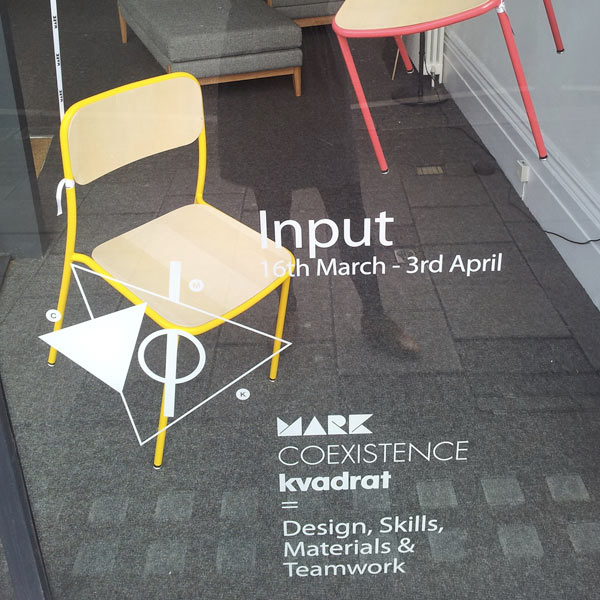

I’ve decided to make a slight change to this column, and feature the design and making processes of other products, as well as showing you things I’ve made myself. To kick off this new approach is a fantastic exhibition from MARK, Product of Cornwall, Coexistence and Kvadrat, which showed every stage of the design process of their Verso chair, from choosing a designer to final product.

The first step is deciding who to work with, in this case MARK chose to approach Tomoko Azumi.

The next step is market research and the development of a brief. MARK are strategic in the way they work – each new piece must not only fit into the collection, but also develop it in some way. This chair was entering a particularly competitive market, so competitors were analysed to find a gap in the market and identify the right price point. At this stage, manufacturing processes are also set, to make sure that the best of local skills are being used.

Next comes concept development and here Tomoko and her colleagues began to sketch out their ideas. She described the process: “Versatility was a key word from the beginning, which we took many ways – a comfortable chair of course, for the versatile human body, adaptable design for many interior styles, variation on materials and colour for basic to higher price ranges, to use the best possible combination of MARK’s production methods.”

The next stage is the concept presentation. Tomoko presented four options, from which MARK’s Anna Hart and John Miller chose their preferred design.

Once a decision has been made on the design, the process becomes about refinement. To ensure the chair is competitive and sustainable, Tomoko looked into whether existing tools or parts could be used to achieve what she was looking for. This plywood is an example of that – a standard radius tool was used to cut multiple seats and backs from the same curved blank.

The next stage is to decide on materials – the crucial decision here was between steel and aluminium, taking into account things like versatility, strength, diameter of the tube, the quality of bend that’s achievable, cost and what each material will look like. At this stage MARK also started talking to furniture dealers about the product.

With key design decisions made, the next phase is production development. Prototyping is time consuming and uses the most skilled people in the factory and so needs to be scheduled in. Key dates were agreed between Tomoko and MARK’s production facility in Cornwall, and the launch date was even agreed with Coexistence.

At this point, prototyping can begin. These ‘first frame’ prototypes are hand-made and so not accurate for size, but they provide crucial details about the manufacturing process and how this will impact on the design.

A series of prototypes then shuttle back and forth between Cornwall and London, along with notes, telephone calls and emails, describing subtle changes like the position of the front legs, the depth of the back and decisions between angled bends and curves.

The next stage is to get people, of different sizes and shapes, to sit in the prototypes, and make any final adjustments required to ensure sure the chair will be comfortable.

The designers then met with Kvadrat to select fabric finishes – colour is an important way to vary the formality and character of the chair between different versions. Kvadrat Remix was selected for the more formal or corporate chair – and Kvadrat Field for a more vibrant look. Paint colours and veneer finishes are also chosen at this stage, enabling visuals to be created for presentation to dealers and specifiers.

All proposed variants of the chair, and additions to the range such as tables are then developed, even those that won’t be produced now. For the launch there were just three versions of the chair (with and without arms), but it’s important to know before production what might be required in the future, because this affects tooling.

Once all the design details are confirmed and good feedback has been received from dealers and specifiers, work begins on production tooling – the press tools to make the curves, the welding jigs and the programming and fixtures for machining the plywood. This is the most significant cost involved in the process, so it’s important to that the stages beforehand have all been carried out. In this case a trial batch of 12 chairs was made and checked, followed by an initial batch of 100 chairs.

Et voila… a chair! I really enjoyed this exhibition and am very grateful to John and Anna for being so generous and sharing their design process. It was a rare and fascinating insight into the world of furniture design.
Further reading for the especially geeky:
Katie, I love the new direction of your column. Discovering the design and making process behind a product really enhances its value for me. I can’t wait to see what other products you will be dissecting in the future!!
Thanks Stacey! I’m really excited about it too!
Really interesting! It’s incredible how much work goes into lots of things we take for granted!