
Matthew Cox’s Elasticated Chair was my favourite find at this year’s New Designers. As I said at the time: “I’m a little bit in love with this chair… I love the colours, I love the form, I love the character… and I know it really doesn’t look like it would be, but it’s one of the most comfortable chairs I have ever sat in.” Once I’d recovered from my giddiness, I wanted to know more about how it was made.
Matthew wanted to explore the properties of elastic to create a modern chair. He wanted to move away from what he describes as the “boxy” and “uniform” chairs that have used elastic to date and create something more attention grabbing without sacrificing comfort.

He started by making a wooden model so he could experiment with the elastic. He drilled evenly spaced holes and wove the elastic between them in a uniform fashion. The tension made the frame collapse, from which he learnt just how much pressure his frame would be under: a stronger construction was required.

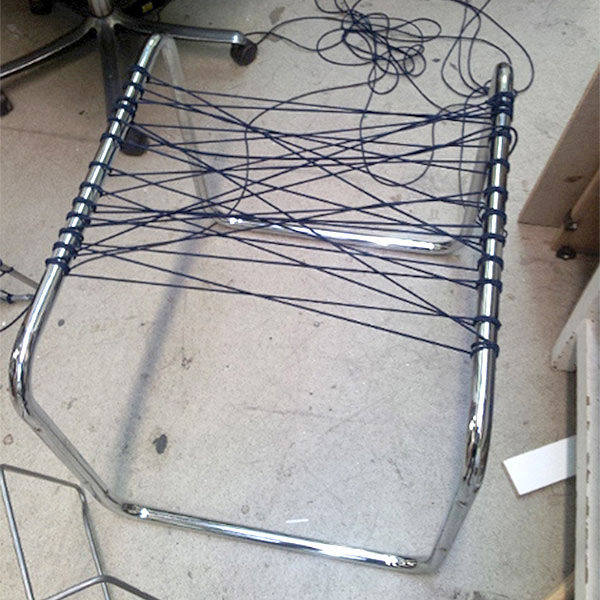
Next Matthew tried steel tubing. He had to find a way to attach the cord so it wouldn’t move around and liked the resulting nautical design element. He experimented with a less uniform arrangement of the elastic to create the dynamic aesthetic he was looking for. Even with a limited amount of cord the makeshift seat held an adult’s weight and felt comfortable to sit in.
He tried with a chair shaped structure and found that again the structure was being pulled in on itself by the elastic, losing 20mm from its width, but it didn’t collapse. He decided to add more support bars to the back and use a thicker tube to give more strength throughout. He decided on 16mm tube for the right balance between strength and weight and created a shape with a continuous profile and four cross bars holding the two sides apart. He drew a 1:1 plan and then started making the chair.

He measured and cut each piece of metal slightly too long in case of any mistakes. Then he bent each piece of metal individually.

The metal was bent using a tube bender. Each piece of metal was slotted up to a pre measured point and bent slowly checking the angle all the time.

Once bent, Matthew lay each one down on the plan to make sure it was correct. It is important that both sides of the chair are identical so they can be welded together easily.

Matthew made wooden blocks to hold the structure in place, enabling him to weld it together in one go. He then sanded it all down afterwards.

Then came the colour choice. Matthew said: “I wanted the color for the chair to be very ‘in your face’ and vibrant so that it attracted people to it, giving the piece a character of its own.” Matthew narrowed the frame colour choice down to yellow, orange and lime green and eventually plumped for yellow combined with blue elastic. It then took him an hour and twelve minutes to attach the elastic…
Et voila…

Further reading for the especially geeky: