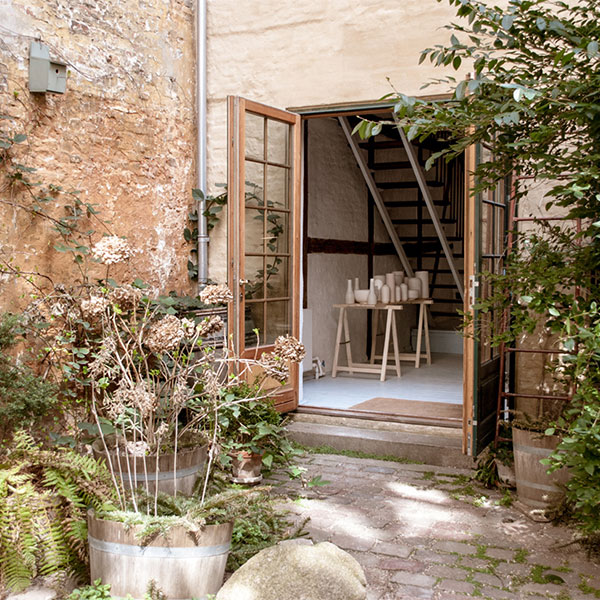

Behind this ancient door at Kompagnistraede 23 in the design centre of Copenhagen, Denmark lies Tortus Copenhagen, a small-scale producer of fine hand-made ceramics. In their words: “Like the noble creature from which we derive our name, we move at our own humble pace.” Sounds like my kind of place…

This is Eric Landon, one of the ceramicists behind the brand. A graduate of the Danish School of Design in Copenhagen, a master potter and a designer, Eric’s love of wheel-thrown pottery started at the tender age of 16. He kindly agreed to talk us through the process that he goes through to create every product he makes.

“One of the most important things in the process comes before we even start our wheels. The ‘wedging’ of clay not only removes air pockets in the clay, but conditions it for throwing on the wheel. Many people underestimate importance of well prepared clay” he says.

Eric then centres the clay, an essential step for ensuring the form that follows will be symmetrical – and I can tell you from experience, even this part is a lot harder than it looks!

After the clay is centred, Eric makes a hole in the top, the first step that turns a lump of clay into a container.

He then pulls the sides up as the wheel spins and begins to shape the container.

Eric says: “The cylinder is the basis for most forms on the wheel. Different shapes, like vases, bottles and many types of bowls are shaped from cylinders. The more perfect the cylinder is, the more easily it can be formed.”

With exactly the right grips and pulls, Eric fights the centrifugal force to shape the container into a the required shape – the example above is going to be a vase.

Once the basic form is completed, Eric carefully shapes the lip of the vase.

Eric says: “We only trim our pieces to the minimum to preserve the natural qualities of the clay surface. However, in this case, the base is trimmed slightly to reveal the classic vase form.”

“Finished!” he continues. “Now the piece needs to dry carefully. Afterwords, it will be fired at 1000 C, making the surface of the vase ready to accept glaze.”

“After the first firing, the pieces are glazed by Karin Blach Nielsen with her own special mix of glazes. Glazes are a mixture of minerals that, when mixed with water, can be applied to the porous clay surface with a number of techniques,” Eric explains. “We use a dipping technique. In a delicately timed process, a series of glazes are applied in layers. If the timing is even slightly wrong, the layers will be too thin, too thick, or just peel off.”

Excess glaze is carefully removed simply using a sponge and water.

Once they’re dry, the pieces are fired again. Temperatures and firing times influence the effects of the glaze, so this process has to be very exact.

Eric says: “I love the magical moment when the kiln is opened and we can examine our new treasures. Sometimes exciting things happen in the kiln that we didn’t expect. We love these types of surprises!”
And here’s the final product… gorgeous, huh?!

Further reading for the especially geeky: