
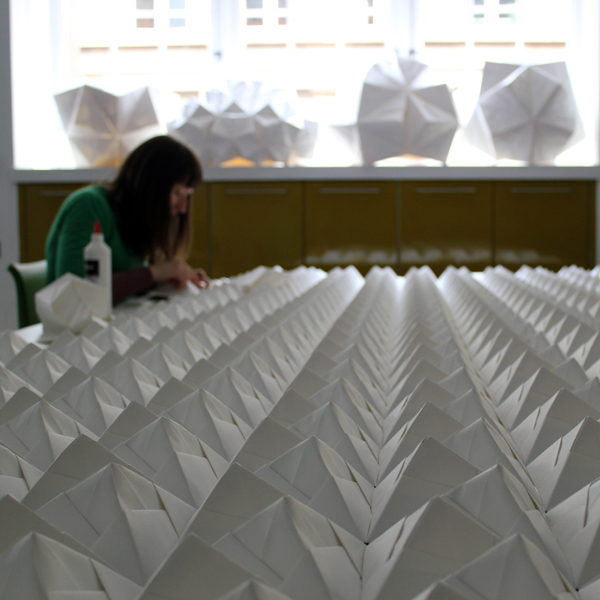

I love what I call “niche geekery” so when Kyla McCallum, founder of design studio Foldability, started telling me about the origami ‘Mitsonobu Sonobe’ module I was immediately fascinated. “The module was designed by Mitsonobu Sonobe in the early 1960s – he used it to create prisms and cubes, but I don’t think he realised its full potential,” Kyla told me. “I discovered that there are so many other shapes you can make from it. It’s almost like a code. I’ve become quite addicted to discovering more and more shapes, the possibilities seem endless.”
Her experimentations have led to the Sonobe Collection, a series of origami lighting designs that are folded and pieced together entirely by hand, which will officially launch at designjunction during the London Design Festival 18 – 22 September 2013.
Before the collection is unveiled in all its glory, I wanted to see exactly how she does it…

“My obsession with origami began about five years ago and ever since I’ve been experimenting and playing with a range of folding techniques,” says Kyla, who graduated in 2012 with a Master of European Design from the Glasgow School of Art.

“Each of the lighting designs are made completely by hand from my East London studio. The designs are constructed from folded, paper squares and a steel, white-coated inner frame.”

Kyla says: “Modular origami creates several different layers. When illuminated, it creates tonal variations and the colours you can get from white paper are amazing – the first prototype was made from normal 80gsm printer paper and it turned out to be fluorescent pink.” Each light is made from a number of hand-folded modules using paper from GF Smith.

“Since then I’ve tested around 50 different papers before settling on Naturalis Absolute Smooth from GF Smith.”


“First I fold the squares in batches and wrap the completed modules in industrial cling film to keep them clean.”

“Every design uses a different number of modules, from 12 to 136. There are three different sizes of modules, which are joined together using water-based glue.”

“By putting three modules together, a pyramid shape is created. I then circle around to create a ring of four, five or six pyramids, depending on the lamp I’m making.”


“I use a variety of steel frames from triangles and squares, to pentagons and more complex 3D structures. The frames are outsourced and made using an industrial wire bending machine,” explains Kyla.

“The final stage is to insert the frame into the structure to complete the light.”


“When I’m exhibiting the designs I often create an origami wall panel to use as a back-drop. The paneling uses the same folds as the lighting designs and is very time consuming to put together.”

“This example is made from 4,917 modules and each 3.5m row took an hour to glue together. In total the wall took about a month to complete.”

“The last time the panel was installed, we needed the help of 10 people to mount it on the wall!”

Make sure you come and see Kyla’s incredible creations on stand F27a at designjunction from 18th September.

Further reading for the especially geeky:
- here’s one I made earlier :: tortus copenhagen
- here’s one I made earlier :: thornback and peel
- here’s one I made earlier :: concrete rug
- here’s one I made earlier :: caslon & co


amazing!