
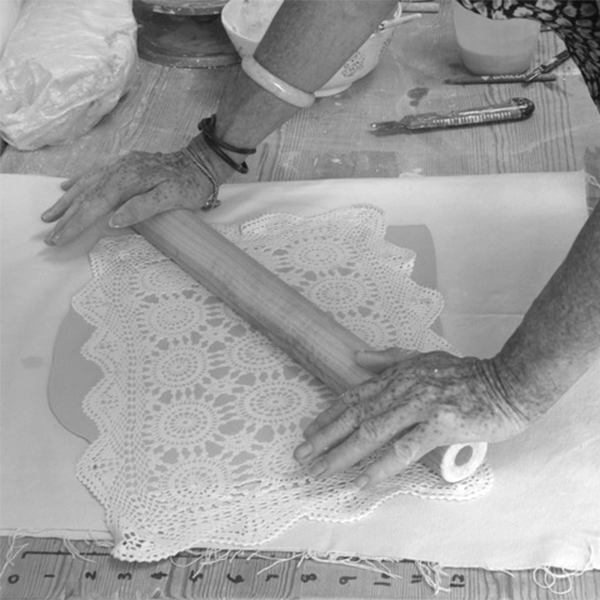
I saw Janet Stahelin Edmonson‘s work at the Craft Central Imprint exhibition in September, ostensibly a show about printing. She uses lace to create delicate patterns in porcelain vases. Having spotted the film above at the exhibition, I was keen to find out more about the process.

“First, the porcelain is rolled out on a canvas cloth to the desired thickness,” says Janet.

“Then the lace is rolled firmly into the sheet of porcelain.”

“The lace is removed leaving a sharp, crisp impression in the clay,” she says.

“Next, the porcelain is carefully cut to shape.”

“The sheet of porcelain is rolled round a cardboard cylinder,” says Janet. “I wrap the cylinder in newspaper to stop the clay sticking to it.”

“Next, I paint the join with watery slip (liquid clay) and then gently press it together to secure it.”

“At this stage, I gently squash and manipulate the cylinder leaving the impression of the hands that made the pot!”

“I cut the base from the left over sheet of porcelain.”

“The base is attached to the cylinder using slip as previously, then trimmed and tidied up with a sponge to ensure a good seal”

“The finished pot is then dried slowly over several days – it takes between three and seven days depending on the thickness and how dry the environment is. When it is thoroughly dry, it is fired to 1000 degrees centigrade after which it can be glazed inside. Then it’s fired again to 1270 degrees centigrade to make it fully watertight so it’s ready to be used.”

“I like my pots to be used -and hopefully loved and admired! For me, that completes the making process!”

Further reading for the especially geeky:
- here’s one I made earlier :: tortus copenhagen
- here’s one I made earlier :: thornback and peel
- here’s one I made earlier :: concrete rug
- here’s one I made earlier :: caslon & co



Wow! Beauty and simplicity.