

As regular readers will know, I am fascinated by the design and making process, often more than by the end product itself, so you can imagine how excited I was about In The Making, an exhibition Jay Osgerby and Edward Barber have curated for the Design Museum. (It was an extra treat to discover that the very talented graphic designers at Build did the exhibition design.) I was very privileged to be part of a fantastic press preview, in which Ed and Jay talked us through every one of the 24 objects in the show, sharing some incredible insights. There’s so much to share, I’ve split this post into two, so this is the first half…

Ed: “We tried to get a very broad range of objects, everyday objects, objects that people are familiar with, and a broad range of manufacturing techniques too, so we hope that people will be able to identify with many of the objects in the show. Each object has been ‘paused’ at a different stage in the process. How we’ve chosen that stage in the process is quite abstract – either it demonstrates a part of the process that we find interesting, or it might just be a point at which we feel the object looks quite beautiful, in some ways even more beautiful than the finished object itself.”

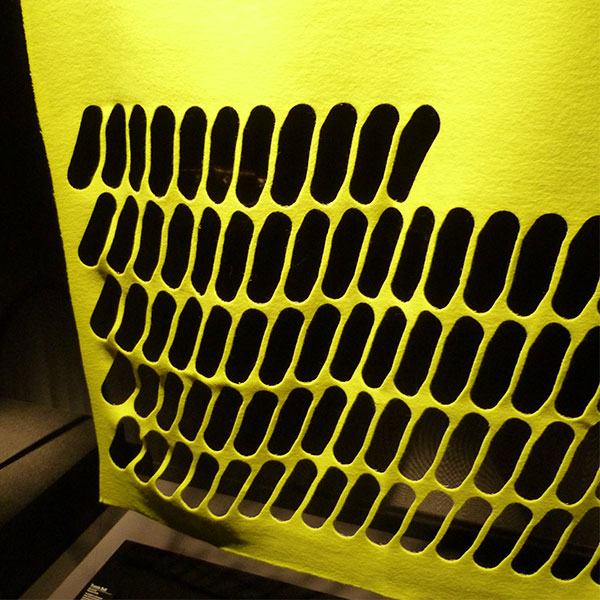
Jay: “The first piece is the salvage from tennis balls. Tennis balls are moulded in rubber and then wrapped in this woven felt that is incredibly hardwearing and incredibly tough. The technique is really old and just relies on glueing one material to another, it’s the properties of the felt, that make it so hardwearing. We also had the stack of the actual cut-outs, but they felt a bit too literal. We were quite taken by the salvage. It looks like it’s going to be doing something itself, instead it’s the left-overs.”
Ed: “We were struck by the incredible graphic quality of it, which is something we pay attention to in our work. We really like a strong graphic and so it just came as quite a surprise to see this.”

Ed: “The next object is a bent beechwood back rest and back legs from a Thonet chair. We just feel that this is the most beautiful, sculptural piece and in a way it is more beautiful than the finished chair, because it is so pure. It is a very industrial process using natural materials. The process is about 170 years old now, and it’s still being done exactly the same as it was. The machinery has been updated, but the process is the same.”
Jay: “What’s beautiful about it is its sinuous form. It still retains its form, it still retains it woodiness, but it could never grow like this. The way the section gets thin where it needs to be thin and fatter where it needs to join to something, in one fluid motion… it describes its ultimate use, exactly what it needs to do where, so in that sense it’s one of our favourite pieces.”
Ed: “I think that best illustrates stopping something halfway through and it looking almost better than the finished product.”

Ed: “The pencils are very low tech and the result of a process that’s been used for 300 years – a piece of graphite sandwiched inside wood. The wood is to strengthen the graphite and to stop it going all over your hands. While we were looking into this, we researched the history of the pencil and we realised that graphite was an incredibly valuable commodity at one point and there were graphite mines and they used to flood the mines so people couldn’t go down and steal the graphite…”
Jay: …”and graphite was found in Cumbria, so the pencil was really invented here. Originally it was used for marking sheep, so everybody knew whose sheep was whose, and during the Napoleonic wars, the trade of graphite was stopped. France was not allowed pencils, so they couldn’t tell which were their sheep! We love the fact that it’s beautifully low-tech. One of the other points of this show was about finding a point in the process where you could stop it and be really happy to have that object as a curiosity yourself if you saw it at a flea market or in a shop, you’d wonder what it was but you’d want to keep it because it had an interesting story, or because it was a beautiful thing, and that’s certainly the case with this one.”
Ed: “The reason they make ten pencils in a row, is that that’s the way the cedarwood planks arrive from North America – there are some things that really demonstrate efficiencies in the manufacturing process.”

Jay: “The next piece is a childhood curiosity. We’ve all wondered how marbles are made. It seems impossible, so we thought it was quite a nice way to show it. This particular marble is still attached to its stem. It’s made in glass – different glasses are put together and then twisted. Then this shape is formed, and they keep on working it and working it until that piece comes off and then it’s polished.”

Jay: “People will be quite familiar with the Olympic Torch that we designed, but probably don’t realise that it started life as a flat sheet that is cut with the world’s fastest laser.”
Ed: “We had 8,000 torches to produce and each one had 8,000 holes in it, and that created quite a problem, because there were 64,000,000 holes to cut and the technology that was available to us in Britain at the time, meant that it would take about eight years to make the torches…”
Jay: “…which was bad news because we had 18 months!”
Ed: “…so the company who produced the torches had to invest in some slightly faster laser cutting equipment. It could cut 16 holes a second, which meant they could do it a few months. This is the outer sleeve. The torch was made of two almost identical sleeves and then formed into a triangle and welded together.”

Ed: “From very high tech to very low tech, this is how corks are made. This is from a factory in Portugal, just outside Porto. Cork takes a very long time to grow. It takes 25 years from a seedling before the tree is ready to take cork from and then you can only take cork from it every nine years, and so it’s a very expensive material. Therefore when you’re making it into corks, you’ve got to be quite precise. You don’t want to mess it up! What these guys have to do, at very high speed, is to get as many corks as they can from each piece of bark. They get them as close together as they can without overlapping and as close to the edge as they can without compromising the quality of the cork. I went to the factory to see how they do it and it’s quite extraordinary – highly skilled and very fast.”

Jay: “I’m not sure most people realise that Apple computers are machined from solid aluminium. It’s a very special alloy, but what it means is that they can keep the tolerances they need to perfection. When you’re pressing material you get wear on the tools, so it starts to change shape slightly. But when you machine something from scratch, every one is perfect. And because Apple insist on perfection, this technique is perfect for them.”
Ed: “It also means you can modify the design within minutes, rather than having to make another mould or another tool, which could take months.”
Jay: “What’s very special about aluminium, unlike many other materials, is that it doesn’t downgrade when you recycle it, so you can keep using it again, and again and again. So the 64,000,000 holes that came off the Olympic torch, all got recycled and used for other torches, and the same is true for the Mac Books, everything that’s cut away is reused. What’s quite nice about this piece, is that’s it’s so cumbersome and heavy and unportable – it’s amazing to think that something so sophisticated could be made out of that lump of aluminium.”

Ed: “Then we’ve got the glass body from a lightbulb. But I think what we’ve shown here is that that’s actually blown glass.”
Jay: “The halogen lamp is used because of energy efficiency, so we now put halogen lamps inside light bulbs, in a desperate attempt to preserve the archetype which is the form of the lightbulb. We’re trying to modernise the technology but keep the iconic form of the lightbulb, which is so familiar and so beautiful, but it’s just amazing that over time something which is produced through necessity has come to represent something that emits light even though it doesn’t need to be that form anymore.”

That’s the first half of the exhibition and I’ll bring you the second half in a few weeks.
Further reading for the especially geeky:
- out and about :: in the making (pt 2)
- out and about :: coadg bursary at home london
- out and about :: east london design show
- out and about :: cornwall


hey, this is pretty awesome. how did you guys get hold of the tennis ball salvage?