
I met Kate Farley at Tent London during the London Design Festival and was immediately captivated by her quiet passion. Her surface pattern designs are inspired by Britain’s gardens. I was keen to find out more…

What’s the most important thing to know about you?
That I care.
How did you first get into what you do now?
I’d blame Tony Hart. I loved watching Take Hart in the 1970s. Since then I’ve been on an interesting journey incorporating drawing, pattern, printmaking, textiles, book art and public art, both being taught and teaching these subjects myself. Creating my own design collection has been a natural progression in my practice.

What inspires your designs?
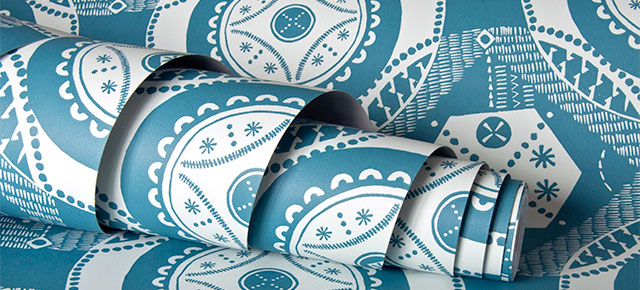
My current Plot to Plate collection was inspired by allotments and kitchen gardens of Britain. I am interested in generating pattern representing human interaction with landscape; what we do with places and spaces as we experience our lives. Worn paths across fields, dug vegetable patches, formal garden borders etc.
I am inspired to make pattern when I see midcentury commercial design by the likes of Enid Marx, Edward McKnight Kauffer, Edward Bawden and Eric Ravilious.

How do you overcome creative block?
I find something else to do; tidying the studio helps. Going back to drawing and enjoying it just for the sake of it often works too.

Talk me through your design and making process from initial idea to final product.
I start with drawing. I have a huge archive of sketchbooks of drawings I make while wandering around kitchen gardens or formal borders making drawings as if surveying or mapping.
The diagonal diamond structure was something I’ve been working on for a couple of years, so it was exciting when the drawings started to become a design in ‘Parterre.’

Next I cut a lino block print for the image quality, scan the print in and work on the computer to compose the final design composition and repeat. I sometimes make limited edition lino prints as a result of this process. I spend months honing every aspect of the design, including the scale of the pattern in relation to the end product.
For the Parterre notebooks I hand screen print the covers and sew each book myself. For other products I outsource the production, which involves lots of conversations and sampling to get it right but it’s a pleasure working with British manufacturers.

What’s your favourite part of the process?
Turning the raw ingredients into a design. It can be frustrating but exhilarating too. Each adjustment to the design is another discovery.

What’s your favourite tool?
Time… and a sharpened graphite pencil.

What are you most proud of?
Being able to have such a varied portfolio of projects behind me that I have learned from despite being a lecturer and mother. My professional experiences feed my teaching so the successful students I’ve taught make me proud too. I came face to face with several I had taught over a decade ago when I exhibited at Tent, and I even remembered their names! I was so pleased they came to say hello.

What advice would you give to a new designer?
Develop strong relationships in the industry – respect other people’s knowledge and experience and start conversations. Enjoy the journey; it’s not the destination that matters, by then you’ll be in a box!
And finally, what’s your favourite colour?
Teal, but my idea of what exactly that colour is alters frequently.

Further reading for the especially geeky:
- interview :: kate shaw, cordello home
- interview :: pattern foundry
- interview :: hokolo
- interview :: head & haft