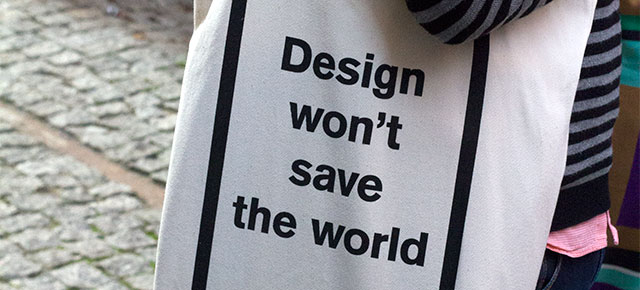

One of the most exciting things about launching Fiera Magazine, is that it allows me to go to even more design festivals to meet even more new designers! As well as Designblok in Prague, I was lucky enough to go to the Lodz Design Festival in Poland. I loved their branded bags, which read “Design won’t save the world” – refreshingly honest, or disappointingly pessimistic depending on your viewpoint!
One of the real highlights was Test Zone, a space in the centre of the newly restored textiles factory where the festival was set, dedicated to enabling people to experiment with processes and materials.

Around the edge of the space, products and their processes were shown together – I loved seeing how Jan Lutyk’s Ribbon chair is made by dampening lengths of laminated wood and then winding them around pegs so they dry in the required shape.

And this is the finished stool in its natural habitat in Jan’s home where I was invited for coffee, bread, homemade jam and an interview later in the week – watch this space for more on that!

Elsewhere in the building, there was a photography exhibition by artist and photographer Charlie Koolhaas, drawing parallels between five cities: Dubai, Guangzhou, Lagos, Houston, and London, in order to reflect on what globalisation really means. I loved this little girl counting cars!

I loved Narcissus by Polish design duo New Craft – the hand-blown glass vessels each have a copper collar that lets the plant enjoy its own reflection.

I love a bit of concrete, and Konkrety by Alicja Patanowska was no exception – simple forms cast in lemonade bottles to form desktop accessories.

Daniel Charny, Director at London design studio From Now On, curated an exhibition called Brave Fixed World, a take on the festival’s Brave New World theme, to counter the ‘ending is better than mending’ slogan of the Aldous Huxley novel. Manifestoes from various organisations that make up the repair movement were displayed on one wall.

Hal Watts‘s Esource is a simple and cost-effective way of enabling people in developing nations to recover valuable metals from discarded objects more safely.

The Maker Library Network is a British Council concept aimed at connecting creatives in the UK and South Africa. It is an open network that anyone can join – you just have to share your skills, share your books and show other people’s work in your space. The smallest studio to have joined is a two-man band who offer workshops just once a month.

Unfold and Kirschner 3D collaborated to design a Digital Calliper, used here along with 3D printing to turn an unwanted glass vase and a pencil into a jug.

The Redo Studio was established by Gaspard Tine-Beres and Tristan Kopp to investigate alternative production methods, with the aim of reducing the cycle between the manufacturer and the end user. Their Redone coffee maker is made by rehousing salvaged parts in cork.

Another highlight was the Make Me! Competition New designers, makers, students and graduates from art and design backgrounds are invited to submit their work, and this year 21 projects were selected from the 247 applications; and one winner chosen to receive the overall prize of PLN 20,000 (approximately 4,000 GBP). Above: The Swallowtail Mirror by Australian designer Bernard Benny.

Plantacja (Plantation) by Alicja Patanowska combines discarded glassware she collects from the streets of London in the early hours of the morning, with hand-thrown bespoke ceramic forms, giving each one a new function as a plant pot or vase.

Flexible Order is Tapei-born Fabricia Chang‘s attempt to give people the tools to break out of the aesthetic conformity she noticed in the Netherlands while studying at Design Academy Eindhoven, and express their own personal aesthetic preferences, albeit within uniform and considered parameters.

Latko & Fragstein aka Michał Latko and Łukasz Fragstein designed A1, the first model from a collection of products that use the vanishing crafts typical of the Silesia region – an area of Central Europe now mostly in Poland, with parts in the Czech Republic and Germany.

And finally, the winner of the 2014 Make Me Competition was Studio Blond & Bieber (Essi Johanna Glomb & Rasa Weber) with Algaemy – an analogue textile-printer which produces its own pigment made from algae. The resulting textiles changes colour over time when exposed to sunlight.

Further reading for the especially geeky:
- out and about :: art house, designblok
- out and about :: openstudio designblok
- out and about :: superstudio, designblok
- out and about :: tent london, LDF14


Is that bag being ironic ? I suppose it depends what your definition of design is. Living in a metropolis in 2015 is difficult to sometimes see the potential beyond the superficial. Living in a tiny village in the third world really focuses the existing problems and it is often the small projects that use appropriate technologies that make the biggest difference to peoples lives. Having worked with some of the poorest in the world I think I can say that design is the ONLY thing that can change / save the world.
Keep up the good work Katie as you are also making a difference