
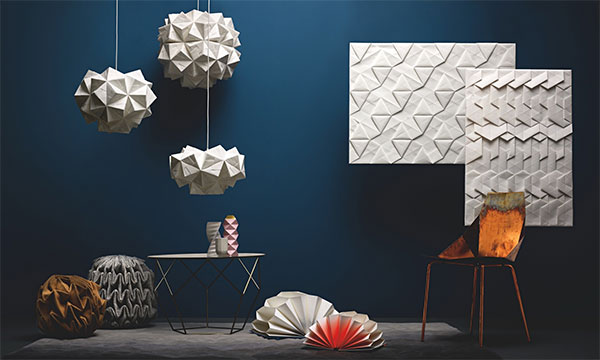

In a light-filled east London studio, designer Kyla McCallum is folding paper. Sheet by sheet, she makes 11 folds in each of 70 pieces of Italian parchment. She talks as she works, barely watching what she’s doing, her hands moving automatically. “This module was designed by Mitsonobu Sonobe in the early 1960s,” she says. “He used it to create prisms and cubes, but I don’t think he realised its potential. There are so many shapes you can make. I’ve become addicted to discovering them.” An hour later, she is surrounded by 70 paper pyramids, which she carefully glues together to form the Chloe Pendant (£275, John Lewis, foldability.co.uk).
McCallum is far from alone in her fascination with paper – the British Origami Society now has more than 700 members, origami motifs and techniques have appeared on the catwalks of everyone from Issey Miyake to Gareth Pugh, and there has been an explosion in home accessories inspired by the Japanese art form. So, why the sudden fascination with this ancient material?
Paper is disappearing from our lives. Diaries have been replaced by online calendars. Letters have been substituted for emails. Books have been swapped with e-readers. As our lives become increasingly digital, we are hankering after something more tangible.
“Today’s generation of creatives has limited opportunity to touch, smell and fall in love with paper,” says John Haslam, managing director of GF Smith, McCallum’s paper supplier. “The digital world is here: we need to fully understand the merits of digital versus the power of paper. Ask a graduate if they want their BA Graphic Design certificate as a PDF or a hand-signed Parchmarque.”
Paper’s increasing scarcity is at the root of its growing appeal. The library has usurped the wine cellar as the must-have addition to luxury properties; interest in rare and first edition books is soaring; and a new independent print magazine seems to launch daily. “Lovers of independent publishing talk about the pleasure of sniffing the pages, so much so it has become a cliché,” says Steve Watson of independent magazine subscription service Stack. “There is more to this physical object than can be conveyed on screen.”
Perhaps it is this physicality of paper that’s driving people to surround themselves with it at home, creating a retreat from the demands of their smart phones, computers and tablets. But it must also be due to paper’s eco-credentials; sustainably sourced, recyclable, and biodegradable, it is stealing a march on plastic as the go-to design material. And where materials lead, aesthetics follow.
Tracey Tubb’s hand-folded wallpaper is created from single strips of non-woven paper. Pleating and other origami techniques, as well as drawn lines and stitches, turn it into something three-dimensional. “Paper can be transformed into something beautiful by folding it,” she says. “Origami products are often white, enabling them to integrate into existing interiors, yet their sculptural nature can make them real ‘wow’ features.” (traceytubb.co.uk)
The European version of origami, napkin folding, thrived during the 17th and 18th centuries, but has now largely been forgotten, preserved only by our more recherché restaurants, and certain hotels’ penchant for turning towels into swans. Historian Joan Sallas puts this down to the introduction of porcelain, which replaced folded napkins as the dining-table status symbol of the nobility. So it is apt that napkins were the inspiration for Moij Design’s porcelain Origami Dishes (from £5.21, Etsy). “We were folding napkins when some of them opened up and happened to resemble bowls,” say the designers. The collection is made using paper moulds soaked in plaster. The pieces follow their moulds, right down to the individual creases that make each one unique. “Origami-inspired products are different from mass-produced goods; they have a playful, hand-crafted aesthetic.”
The trend has made its way into furniture too. Jule Waibel’s pouffe-like ‘cone’ seats (from £300, julewaibel.com) are made from wool felt pleated between two layers of folded paper and set using steam. The folds flex under the weight of the sitter. “I always have been passionate about folded surfaces,” says Waibel. “They’re ornamental, but also mathematical. When the stools expand, they create a beautiful pattern and, in contraction, every fold has its place and closes perfectly.”
Fusion by Nendo (from £12, BoConcept) is a collection of paperfold-patterned furniture and accessories. “We transferred origami folds onto the exterior of cups, and drew the origami animals that result inside,” the designers explain. “Squirrels and penguins appear as people drink, translating the abstract fold patterns into recognisable forms.” The same design was applied to plates, trays, cushions and carpets.
And if surrounding yourself with origami isn’t enough to counter-balance the online overwhelm, the Sesame Origami School offers workshops in London (sesames.co.uk). “Paper folding has been shown to aid relaxation, concentration, hand-eye co-ordination and memory,” it claims. Kyla McCallum agrees: “I used to play the piano and it’s a similar pleasure. You’re doing something with your hands that you don’t have to actively think about. It is just enough to stop your mind racing and leaves you feeling quite serene – it’s like meditation.”
Paper perfect: five origami-inspired products for the home:
1. Blu Dot Real Good Chair. This geometric chair is made from powder-coated steel folded along laser-cut lines. From £155, Heals
2. Orishe vase: The sculptural vase by Headsprung is made from thin bone china to mimic the paper that inspired it. From £35, Hidden Art.
3. Paper Porcelain. The paper models used in Scholten & Baijings’ design process inspired their tableware collection for Hay. From £17.50, Design Museum Shop
4. Plane, Crane and Boat Cushions. Sparrow and Wolf’s cushions feature their namesake origami shapes in pattern form. From £30, Not On The High Street.
5. Plissé. Hay’s hardback accordion folder opens up to reveal brightly coloured pockets for storing paperwork. From £20, Selfridges.

This article was commissioned by the Guardian and first appeared in the Guardian Weekend Magazine on 27 June 2015. Photography by Stephen Lenthall.

Really interesting choice of colors and materials.
The shape of the lamps is so unusual and eye-catching!
Andrew