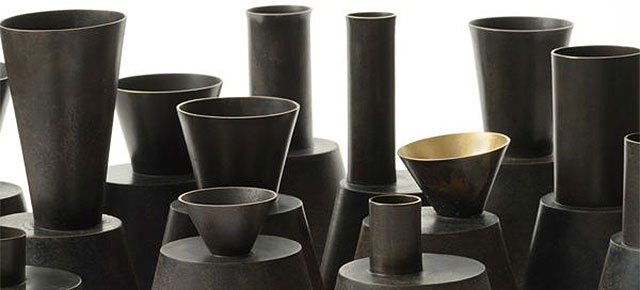

This is the latest in a series of interviews with designers identified by the Design Council as “Ones to Watch“. I’ve been aware of Juliette Bigley‘s work since Nick Wilshire curated The Makings of Luxury, a space at Clerkenwell Design Week‘s Additions focused on craft. Her Conversational Vessels are inspired by the body language we use when interacting with others and how this can be applied to objects. She places her objects in such a way that they ‘converse’ on a table. Juliette’s project was selected in the Everyday Living category alongside Rebecca Price’s Store and Pour storage jars, designed to help people with portion control; and Oliver Hrubiak’s Finn Lounge Chair that challenges contemporary ‘disposable’ furniture.

What’s the most important thing to know about you?
I am fascinated by how we use objects to shape who we are and how we live. How we shape our identities through the objects we choose and how we shape our worlds with them is the basis of my work, and I am endlessly intrigued by the rich symbolic and metaphorical aspects of everyday objects – like spoons and bowls – that haven’t changed their forms in thousands of years. Playing with these ideas and the forms that emerge from them is what gets me out of bed in the morning.
Talk me through your design and making process.
My work usually begins with questions about how we perceive or relate to objects or how we negotiate our place in the world. These often emerge through something I observe in myself or in other people – something I’m curious about and want to know more about. Once I’ve articulated the question, I start exploring it. I’m quite driven by words and writing and these play a large part in my research – I also use photography as a different way of framing the world. I’ve found that the more fun the method, the more I get out of it – if it feels like work, it probably won’t be very productive!
Once I’ve collected some ideas, hypotheses about my subject will begin to emerge (I enjoy the quasi-scientific approach I use – it makes the design process feel under control, rather than in the lap of the Gods!) and I start testing those. I’m not someone to whom drawing comes easily (or very productively!) so I get modelling as soon as I can. Choosing the modelling material is interesting because it radically affects the shapes I end up with – modelling in a clay body gives certain shapes and modelling in paper completely different ones.
My work is both sculptural and functional so I start with the form and then adapt it for function. Once I’ve got some models I’m happy with, I start testing them for functionality – how they sit in the hand, how they pour etc. This allows me to finalise the design.

All my work starts off as flat sheets of metal and the first stage is to decide which metal to work in. This will be partially dictated by the function of a piece: whilst it’s okay to put flowers in oxidised base metals, it’s not safe to drink out of them – and the thickness of metal. It’s important that my pieces have weight and heft in the hand – that they feel substantial, but when I’m working in precious metals, this needs to be offset by cost.
I use many different techniques in work including forming – shaping metal around various tools, fabricating: constructing composite shapes, raising: a specialist technique that consists of constructing three dimensional shapes from a single flat sheet of metal with no seam using only hammers and stakes, and spinning: the process of forming simple three dimensional shapes by hand but using a machine. Within these processes I use many metalworking techniques from caulking (hammering edges to thicken them), piercing (cutting the metal with a very fine blade), filing, hammering with metal, acrylic and wooden hammers and annealing (heating the metal to an appropriate temperature so it is soft enough to work with). For fabricated work, seams will be soldered (at around 800C) and parts will be made and assembled as the piece progresses towards its finished shape. For raised work, this means round after round of heating and hammering as the object slowly takes form beneath my hands before it is planished (‘ironed’ with a hammer) to remove hammer marks.
The final step is the finish – and in metal, this is extremely time-consuming. The rule is that however long it took you to construct the piece, it will take at least that time again, if not longer, to finish! Finish consists of taking out any marks put into the piece as it has been made and putting the final ‘look’ on the piece. For some, this means a polished finish but for me it means layering a textured, matt finish on the surface of the metal using a variety of abrasives to get a soft but reflective surface that is easy to maintain and beautiful to look at. After this, some pieces may be coloured and in the case of precious metal, the piece is taken for hallmarking.

What’s your favourite part of the process?
Overall I think the beginning and (nearly) the end of the process – the initial rush of a new idea and then the actual feel of a piece coming together and developing under my hands. Having said that, every stage of the process has its own challenges and excitements and there are moments in the making process where things that happen by accident open up whole new avenues of enquiry or suddenly make you see things a different way – they are pure gold.
What’s your favourite tool and why?
That’s a very tricky one! On the design side, probably my dictionary – words are a really important part of my practice and to know the specific definition of a word together with its origin is essential. But then I couldn’t design without my thick, indelible markers in a range of colours. On the making side, no silversmith would be without their hammers!

Tell me about a really good day and a really bad day in the life of Juliette Bigley.
A really bad day consists of too many deadlines to hit and not enough time (at the same time, deadlines are sometimes a good thing too). A good day consists of a day free to make in the workshop with a clear idea of what I’m making – but with room for things to change and develop within it, good coffee and a swim at the end of the day!
What defines good design?
Good design is interesting design. Interesting design is a well-framed question answered articulately through form.

What are you most proud of?
Swimming all 10.5 miles of Lake Windermere at 14.5 degrees with no wetsuit. That, and a career change so far successfully achieved!
What advice would you give to an aspiring designer?
Keep at it, keep at it, keep at it: the more you do, the better you get.

What did it mean to you to be selected as one of the Design Council’s Ones To Watch?
It is inspiring to be chosen as someone who may be able to contribute to the future of design within the UK and to be nominated alongside such a diverse and exciting collection of designers.

And finally, what’s your favourite colour?
You do like difficult questions! Probably a very rich purple.

Further reading for the especially geeky:
- interview :: james molkenthin
- interview :: felix faire
- interview :: felix bell
- interview :: feist forest