

In this week’s column, Fixperts Resident Maya Alvarado shares another day looking for fixes at British furniture manufacturer Benchmark – this week she has an idea for a floating Fixperts Day, visits a nearby school for children with learning difficulties, and meets up with local resident Mrs Ellis to start work on her first fix in the community.
06:45: I wake up, take a shower and eat breakfast.
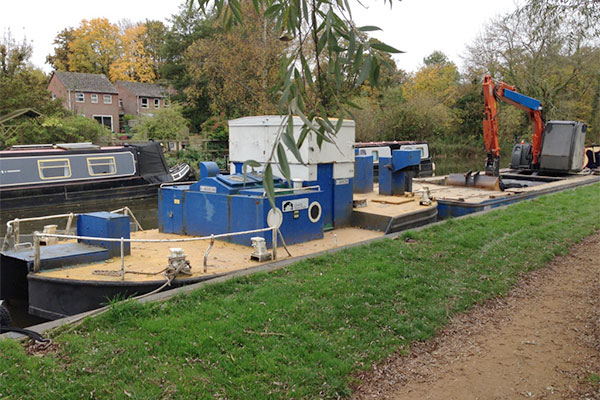
07:40: I cycle to work today on the back road over Hungerford Common. It is super-fresh in the open countryside. Along the canal there is a construction barge moored up. I think about an idea for a ‘making raft’ that could be used for a fixing day with the canal community. I imagine there must be lots of little problems associated with living on the water.
08:30: When I get into the office, I sketch a few ideas for what this raft could be. I think about what materials should be there. Sugru and watertight sealants could be useful for fixing water related issues. In the same vain as the digger on the barge, I plan simple tools that could be fixed down to a workbench on the raft. It could also be a day festival where members of the village get involved.

9:45: I make a batch of needle threader prototypes. The jigs still work well after changing a few dimensions of the block. Packers ensure that the wood is held securely in place for drilling. I switch to a saw toothed forstner (circular) drill bit to stop the wood from burning. The extra teeth remove material faster. As a collection, it strikes me that the ‘houses’ have formed a little community!

12:00: I leave Benchmark to to meet the team at The Castle Post-16 School in Newbury. I had found the school through an internet search and contacted them to arrange a visit.
13:00: I arrive at The Castle School and meet head teacher James Hewitt. As we walk around, I tell him about Fixperts and hear about the school and the wide range of complex needs of its pupils, all of whom have learning difficulties. The main aim of Post-16 is to get students ready for the work environment. External placements are a regular occurrence, as is cooking for the school’s in-house café. We discuss the potential for a collaborative project and James quickly suggests Heidi as a suitable Fixpartner. She is out that day, so I do not get to meet her, but I hear that Heidi, who has cerebral palsy, is a very lively and active student who loves to cook. We arrange a date for me to return after half term to meet her.

15:30: I arrive back to the Benchmark workshop and test hooks for the threader, including a thin bulb filament part that sadly turns out to be too flexible. For the past few weeks I have been on a search for a thinner rigid metal rod for a hook that will pass through smaller needles. Liz Corbin from the Institute of Making was really helpful in putting me into contact with makers of specific metal alloys. However, I am yet to find one that is produced small enough.

16:30: I use an epoxy resin easy-bonding adhesive to attach the hook to the wood. I used masking tape as a tool for keeping the hook in the right place. After setting, I pull the hook to test its strength and it is fixed tightly enough. I test the needle threader and it works well. It is time for some user testing. I show Pete who is nearby and he is able to use it. The main thing is that the hook bends back far enough to keep the thread in place as it is pulled through the eye of the needle. Being the first Fixperts Resident, this is the first time I am conducting Fixperts projects on my own and for a longer duration of time. This changes the dynamic and reflection process. It would be amazing if other companies took on the Fixperts Residency programme. I can imagine the great opportunity for group feedback sessions and comparisons between experiences.

18:30: I arrive at Mrs Ellis’ house for a Fixperts meeting. Mrs Ellis and Mireya, her carer, have already been discussing possible ideas for problems that need fixing. The ramp to assist Mrs Ellis when moving out into the garden would be very useful however is not so crucial in this weather. A more pressing problem is that of eating. Mrs Ellis currently uses the tray from her walker as a surface for her plate, by placing it on her lap. At this height, she is bending down slightly and has the risk of it slipping. I will begin designing a new tray that will parasite off her walker and provide a better height for eating. Mrs Ellis is currently knitting a hat to give to the Samaritans charity for someone who will be homeless this winter, so she too is Fixperting.

Further reading for the especially geeky:
- interview :: made by michael
- interview :: nordvink
- interview :: james molkenthin
- interview :: richard hardy