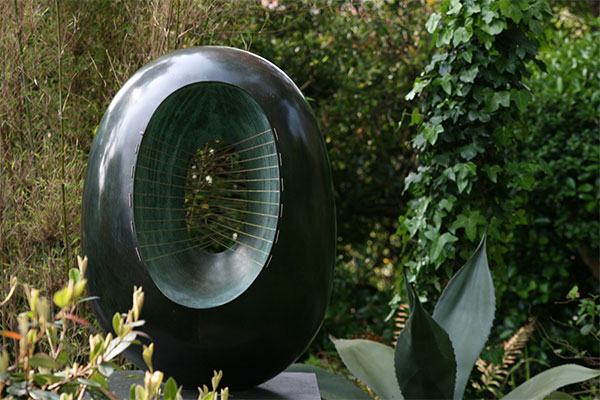

Barbara Hepworth, Two Forms (Divided Circle) 1969 , Bronze, 237.5 x 233.7 x 54 cm, Tate, ©Bowness, Photo: ©Tate, Marcus Leith
If you missed the Barbara Hepworth retrospective at the Tate Britain, maybe it’s time to head South West and check out her Sculpture Garden in St Ives. The Barbara Hepworth Sculpture Garden in the Cornish seaside town of St Ives is one of the highlights of any trip to the Westcountry, especially in the winter, when the crowds of tourists have gone home and the sea and sky can be every shade of blue and grey.

View of Barbara Hepworth Sculpture Garden in spring with sculpture: Barbara Hepworth, Spring 1966, Bronze, 85 x 57 x 53 cm, Tate, ©Bowness, Hepworth Estate, Photo: ©Tate. Marcus Leith & Andrew Dunkley, 2007
Hepworth was born in Yorkshire in 1903, and came to live in Cornwall with her husband Ben Nicholson and their young triplets at the outbreak of the Second World War in 1939. She lived and worked in Trewyn studios, now the Hepworth Museum, from 1949 until her death, caused by a small fire in the studios, in 1975.

Barbara Hepworth, River Form 1965, cast 1973, Bronze, 870 x 1930 x 688 cm, Tate, ©Bowness, Photo: ©Tate, Marcus Leith & Andrew Dunkley
The Hepworth Museum is fascinating, but the real joy is the Sculpture Garden because it enables you to see the sculptures in the environment they were created for. “It’s lovely to live with a sculpture,” Hepworth said, “because it changes in every possible light; all through the day, moonlight, artificial light – any light – it’s always changing.”
This short film by Tate Shots, which includes archival footage from a 1973 interview with the artist, goes into more depth about what the space meant to her:
A visit to the garden enables you to get up close to the sculptures and really interact with them, just as Hepworth intended. Seeing children running under, through and around them is a far cry from the ‘do not touch’ signs that often accompany sculptures in museums. “Everything I make is to touch, and people usually do, which pleases me,” said Hepworth. “And it’s very important to a sculptor, not just to go, sort of, ‘plonk’ up and look, because it changes all the time. So the real thing for people is to move with their bodies. If I’ve made them do that, then I’m very happy!”

View of Barbara Hepworth Sculpture Garden with Torso II (Torcello), Barbara Hepworth, 1958, ©Bowness, Photo: ©Tate
If you’re in Cornwall, and you get chance, it’s well worth a visit. Just make sure you “move with your body”!