
This week, Benchmark’s resident Fixpert, Maya Alvarado visits The Dingley Early Years Centre, finds some seats to fix and starts the refurbishment of a small sofa…
06:20: I wake up and get ready for work. Today I’m looking forward to visiting the Dingley Centre, a specialist early years centre for children with additional needs and disabilities. Having met the fundraising coordinator Janice Powell earlier in the week to discuss the potential projects I am excited to hear more. Coincidently, Janice used to manage the West Berkshire apprenticeship schemes including the cabinet-making course at Benchmark – so she is really pleased to be involved with everyone again through the Fixperts project. But first, to the workshop…
07:30: I arrive at the workshop and spend some time making a new paddle prototype for Heidi to take on our canoe day out. I use a piece of rubber shrink-wrap that I cut open to act as a hinge. Having drilled pilot holes I screw this onto two halves of a plywood paddle head to create a folding device. This is intended to push the water on the backstroke and fold to cut through on the forward. This might be a good option for a version that could be mounted to the side of the canoe so Heidi won’t have to hold it all the time.

09:30: Janice kindly comes to collect me to go to the Dingley Centre. Louise Farmer, the centre manager, greets us when we arrive and meet the team. Louise shows me a temporary fix they have installed on a chair to keep the child’s feet at the right height. This is made up of a stack of sensory blocks, but she explains that it does not successfully keep feet correctly aligned. I take a look underneath and there seems to be enough space to add on a bar where the feet could click into place. These details will be dependent on each child, so I will need to measure them on the chair next time they are at the centre.

10:30: The special chairs that cater to support the children ergonomically feature lots of adjustable components, which makes them very large. These heavy chairs must be on wheels in order for the teachers to move them easily, however the wheels also increase their height. The main issue for Louise is that they do not fit underneath the tables, so the children are unable to sit together properly. We discuss the most important components of the chairs – the foot support, back support, armrests and the pommel, which is a sort of saddle form. Louise shows me some chairs that do fit underneath the tables, these come in three sizes: small, medium and large – it’s a bit like ‘Goldilocks and the Three Bears’, but they have the potential to be adapted to provide the correct support and enable all of the children to sit together at mealtimes and other seated playtimes.

11:00: The centre has two sofas made of solid beech frames with foam cushions. The edges are all quite sharp, and the frame doesn’t have a full back, so the cushions often slip through causing the children to fall and occasionally bump their heads. In order to make these a little safer, I offer to take them away one by one and round off all corners and sharp edges. The cushions are covered in a synthetic fabric, which is quite slippery, so it might also be worth changing this. Most of the issues in the centre are seating related, and important to get right ergonomically to ensure the correct support is given to each child. I ask Louise if it might be possible to meet their occupational therapist to get some advice for the individual children’s needs and we arrange a date for this meeting.

11:30: I am travelling in Janice’s convertible, so we pop outside to see if the sofa will fit. Cold as it is, she kindly agrees to drive it back to the workshop with the roof down! We have a laugh trying to seatbelt it in – it might be a squeeze, but it certainly would not be possible on my little bicycle! Janice has been really instrumental in picking up the project and introducing me to the local team – her dedication to the charity is really evident in her enthusiasm!

12:00: We leave Dingley and drive back to Benchmark for me to get started on the sofa.

12:20: Back in the workshop, I check the edges and cushions of the sofa to see what I should change. I want to smooth down every edge, curve the corners and stop the cushions from moving around.

12:30: The back of the frame will definitely need some extra support; perhaps a panel or some dowel lengths. I have a look underneath the foam armrests and they have Velcro securing them in place. I like this method and it is strong, so I will replicate it with the new fabric.

12:45: Using a compass I measure and mark curved corners on the back and sides of the frame.

13:00: I break for lunch – we have delicious Bombay baked eggs prepared for us by Benchmark’s in-house chef. Such a treat!

13:30: After lunch, I round the corners by cutting the excess on the band saw and finishing them on the circular sander.

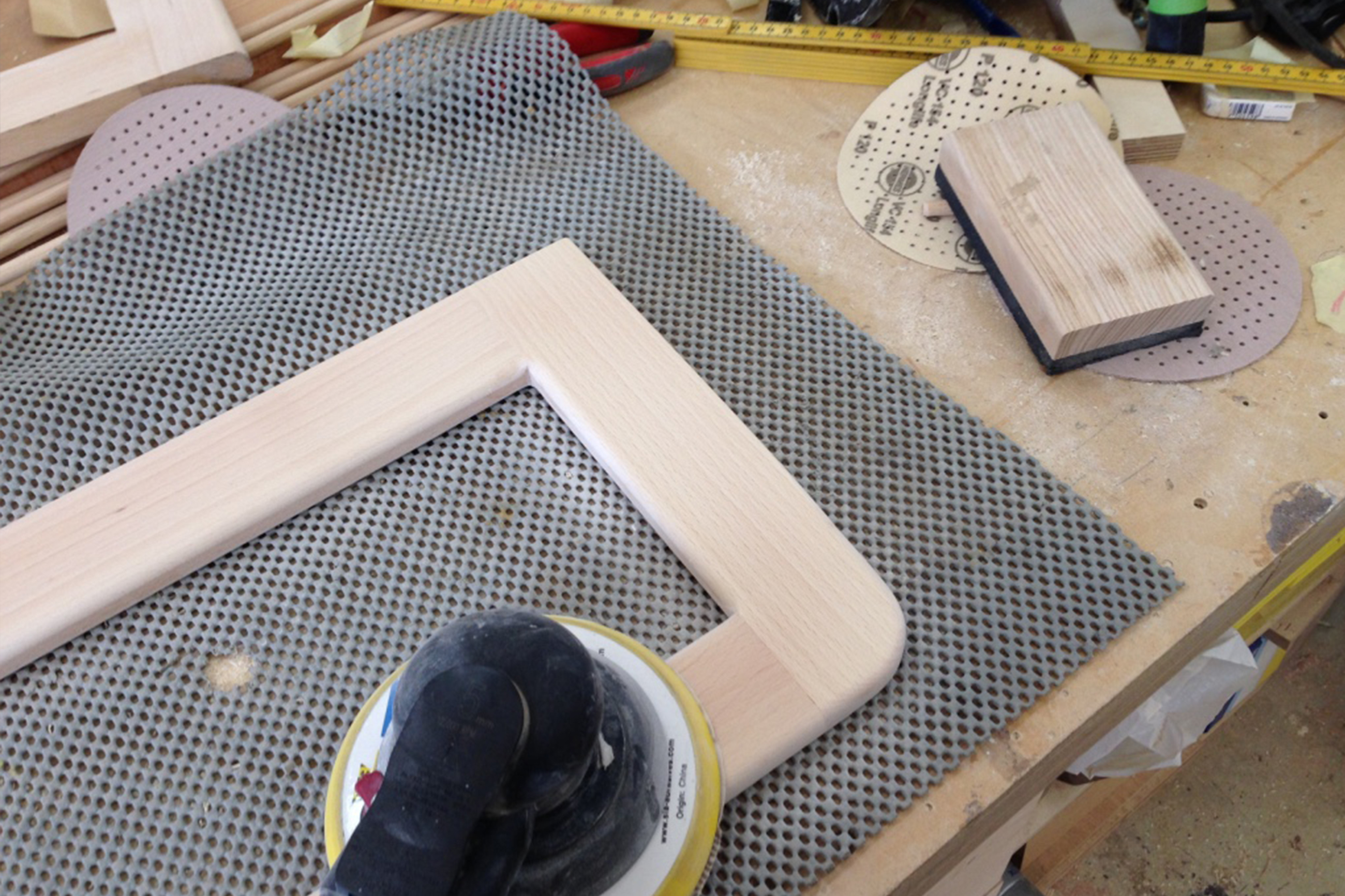
14:00: I use a router with a radius cutter to round every edge, apart from the base of the side panels which act as feet. Then with an orbital hand sander, I remove the remaining lacquer from all the parts.

15:30: I lay down some small lengths of dowel against the back panel to see if they will successfully stop the cushions from falling through. If I use 16 dowels, at even spacing, I can create a solid structure to hold the pads in place.

15:45: In order to secure these in place, I make a box jig (a temporary device that holds a piece of work in place and guides the tool operating on it) that sits perfectly on the inside base and top of the back frame. This can be flipped upside down to locate the same holes in the correct position to receive the dowels.

16:15: Using the pillar drill I make holes at even intervals where the dowels will sit.

16:30: Having drilled the holes deeper in the top, I push in the dowels further then they need to go, and then pull them down into the holes directly below, with a little glue in the base holes.

17:00: I watch the FixFilm ‘Umbrella Stabiliser for Benny’ by Fixperts Shahar Goren and Sagi Shafran for some inspiration. Benny has cerebral palsy and wanted a better grip of an umbrella. Shahar and Sagi make an alternative horizontal handle with an attachment clip for Benny to wear on his jacket to keep the umbrella from slipping. I like the fact the new handle stabilises the umbrella for Benny, folds down to a manageable size and also has a bag clip at its base.
17:30: I head home still covered in dust from a good day’s sanding!

Further reading for the especially geeky:
- A day in the life of the Benchmark Fixperts Resident – Week 23
- A day in the life of the Benchmark Fixperts Resident – Week 22
- A day in the life of the Benchmark Fixperts Resident – Week 21
- A day in the life of the Benchmark Fixperts Resident – Week 20