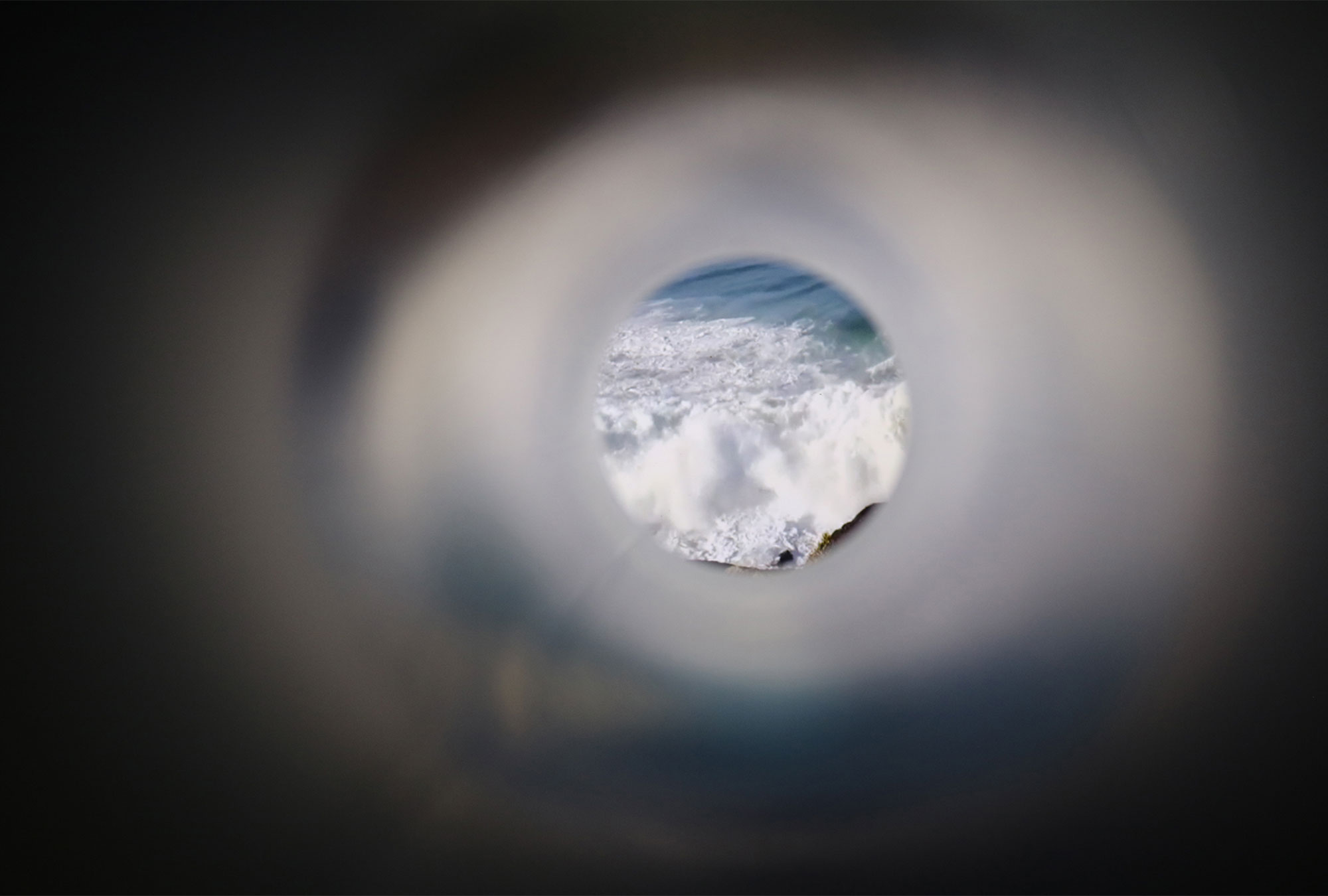

In a modern take on the telescopic viewfinders many of us spent childhood holidays putting 10p into before standing on tiptoes to see a magnified version of the view that was right in front of us, people are invited to put their heads inside a concave dome that narrows into a reflective cone-shaped viewing tube. Sounds from the surrounding area are amplified and the colours and forms of the view are framed by the tiny viewing hole and distorted by the reflective inner surface of the tube.

“By distilling your viewpoint down to a small scale, and focusing on unexpected vistas, HyperCurated encourages you to look at the world with a renewed sense of wonder, with the intrigue and joy of a child,” says Alex. “100 coastal way-posts offer HyperCurated views and unique perspectives on 100 different locations,” says Alex. “Designed to capture what’s special about each place, distilling it to a point of abstraction, allowing you to view the coast through a new lens. These are way-posts to nowhere, but journeys to Wonderland.”

HyperCurtated was originally a response to an open brief from Tour De Coast – a charity whose goal is to encourage visits to and journeys around Britain’s coastline. For this reason the initial proposal is for 100 lenses positioned around the edge of our island nation, but Alex hopes the project can go further. “I see huge potential for the posts to be installed in urban environments – locations where beautiful views are completely unexpected,” he says. “The aim is to further explore this potential and seek funding to help bring the project beyond an artistic concept and into the world as a form of public art.”

Having studied for his undergraduate degree in 3D Design at Falmouth University in Cornwall, Alex has developed a real connection with the sea. “The UK has one of the world’s most beautiful, diverse, dramatic and enchanting coastlines,” he says.
HyperCurated was one of two final projects Alex launched on completion of his Masters Degree in Design Products. His other project, entitled Limpet, is an ocean pollution sensor designed for surfers, swimmers and other people using the waters around the UK. “Limpet attaches to things that go in the water and tells you how clean your ocean is,” he explains. The device uploads the information to an app on your smartphone giving you a detailed picture of the quality of the water you are swimming, surfing or fishing in – and pushes updates to Twitter for other people to check before entering the water.
Both projects were shown as part of ShowRCA 2016, the London university’s annual graduate show held across both the Kensington and the Battersea campus in July 2016.