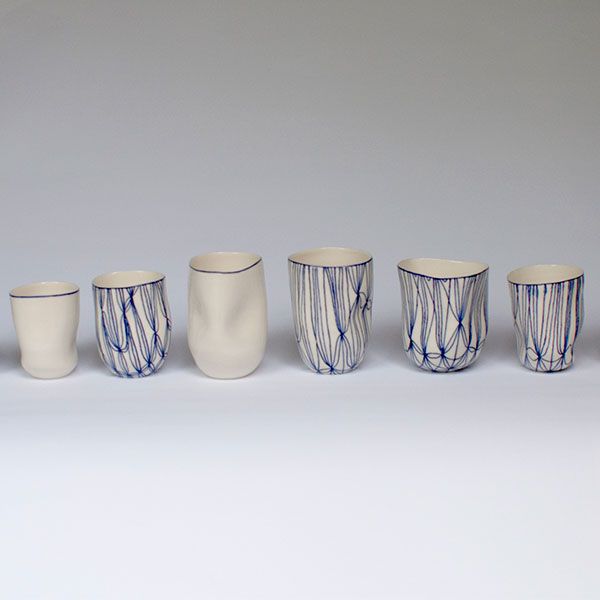

I met Rhian Malin at designjunction during the London Design Festival and was immediately drawn to her passion and enthusiasm. Her Hand Held Vessels collection is shaped in other people’s hands before it is fully dry and then project patterns are traced onto each one by hand. I love the contrast between the ancient making processes and colour palette and the digital influence of the surface design. Having recently graduated from the Three Dimensional Design course at Camberwell College of Art, Rhian is just embarking on her career as a designer maker. I was keen to find out more…

What’s the most important thing to know about you?
I’m a perfectionist, and it drives me crazy.

When you were five, what did you want to be when you grew up?
I wanted to be an artist. If I had a colouring book I was content for hours on end. I probably still would be actually. I always remember my Grandpa telling me off for going out of the lines. I wonder if that’s why I’m such a perfectionist now!?

And now?
Well I wouldn’t change being a designer-maker for the world. I absolutely love it, so I wasn’t too far off with my goals as a five-year-old.

How did you first get into design?
The first time I realised I was good at designing and making was in my Design Technology classes at high school. I was a bit of a teacher’s pet with the head of department so I probably owe quite a lot to him.
But with regards to ceramics I hadn’t even touched a piece of clay until about two years ago when the ceramics course at university shut and the workshop became accessible to the other courses. So there is still a lot to learn but I love a challenge and it’s such a relaxing material to work with which is what draws me to it.

What inspires your designs?
I’m very interested in finding ways of making groups of objects through the same process but at one stage or another introducing something that makes each one unique.
With the Hand Held Vessels project, inviting people to come and squash a freshly thrown porcelain vessel to the shape of their hands takes part of the making process out of my hands and ensures that each one will be different. Then the way the patterns distort to each vessel are completely down to the way that individual person has formed their vessel.
How do you overcome creative block?
By making. Even without a clear aim of what’s being made, I think things are often discovered by playing.

Talk me through your design and making process from initial idea to final product.
I usually get initial ideas from really breaking down the brief to make sure I really understand it, looking at the definitions of words and phrases relating to them. I often discover one really small fact or detail that I find interesting which then spurs on the whole project. I look at other products from designers relating to the idea, and then get straight on with experimenting with materials. I develop ideas through lots and lots of making and experiments, tweaking little things every time, until I’m finally happy with what I have. But as I said, I’m a massive perfectionist so I always see something that could be done better.

What’s your favourite part of the process?
Experimenting with materials. It’s like a grown-up version of playing.

Describe a really good day and a really bad day in the life of Rhian Malin.
A really good day would involve making all day long with the radio on in the background. That would be the only thing on my to-do-list and definitely no emails or writing.
A really bad day, the one that I dread the most, is opening the kiln and finding an absolute disaster after the glazing process. It takes weeks to get to this point, so much time and effort has been put in, and that can all be completely ruined by a whole host of reasons during the last firing. And then you’re left with the daunting task of having to redo everything.

What are you most proud of?
Just getting to the stage where people want to buy my work and galleries want to exhibit it is the best feeling in the world. Particularly as it’s happened so soon after I’ve graduated, I thought it would be years before I got to that stage.

What advice would you give to a new designer?
Just to get yourself out there. Believe in your product and put it in places where it’s going to get seen. If it’s a good product people will start noticing you and then all kinds of exciting things will start happening.

And finally, what’s your favourite colour?!
I haven’t been asked that in years! Probably royal blue.

Further reading for the especially geeky:
- interview :: richard brendon
- interview :: tom pigeon
- interview :: kate farley
- interview :: aud julie befring