
I met Kristine Bjaadal in Oslo on a trip to preview 100{ff546b69e23b1524d799f96c6ba7a638e1f677053b0a2a1568b05315fd5f8fc7} Norway, having been aware of her work for a while – and then of course saw her again during the London Design Festival. We talked inspirations, imperfections and memories…

What’s the most important thing to know about you?
Through my design of everyday objects, I try to turn daily routines to rituals of appreciation. My work is often somewhere between product and craft objects; functional objects made for use, but at the same time sculptural in their form. For me, design is storytelling.
What inspires your work?
Everyday life. Small details that I notice in my surroundings; a nice shape, a surface that is good to touch, contrasts, imperfections. How we leave traces in our surroundings and our inclination to collect memories and keepsakes.

Talk me through your design and making process.
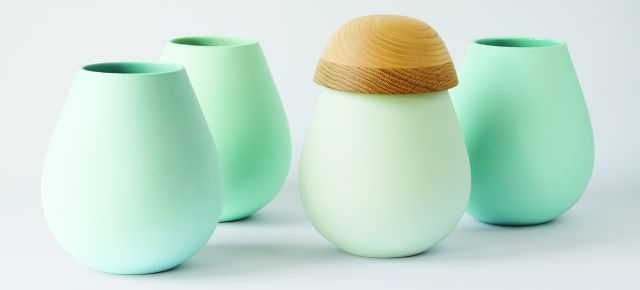
I love the way I can use objects as a means to tell stories about everyday life. I often start out with a vague idea or even merely a specific feeling that I want my objects to possess. For instance, I find the human inclination to collect memories and keepsakes fascinating, and throughout the last few years I have often returned to work with different kinds of containers. A container keeps something. It could be something as trivial as beans, coins or cotton pads; a purely practical function. Or maybe the container is used to keep objects you love, and in this way keeping your memories. A container can even be empty, but still contain the idea of keeping something, preserving something, taking care of something.
I often make sketches in clay or cardboard models – I prefer to work in three dimensions to be able to really see the shapes and sizes. Making prototypes is an important part of the design process. I like to work with my hands, and let my hands have a dialogue with the shape throughout the process. Even though I work with different kinds of materials, I do especially like to work with materials that enable me to make the prototypes myself – like ceramics or cork – instead of sending finished drawings to someone else. Tactility is always very important in my work, so I choose materials that are good to touch; wood, ceramics, glass, leather, cork, wool.
What’s your favourite part of the process?
Making prototypes. When I know what I am going to make, but still have a lot of detail choices left.

What’s your favourite tool and why?
My own hands. They can both create and sense shapes.
What defines good design?
Like all other forms of art it is great when it amazes you. What it takes to do just this is impossible to list in a recipe!

What are you most proud of?
That I have found my own visual language; an atmosphere where all my projects fit in, and that this language speaks to other people.
What advice would you give to an aspiring designer?
Do your own thing. Find our own language. Be positive, stubborn and patient.

What’s your favourite colour?
I don’t know if I have one specific favourite colour – it depends on the use. But I often find myself making objects in different shades of blue and in natural colours such as white porcelain and natural wood.
What did you enjoy most about exhibiting at 100{ff546b69e23b1524d799f96c6ba7a638e1f677053b0a2a1568b05315fd5f8fc7} Norway as part of the London Design Festival in September?
Working as a one person design studio can sometimes be lonely. What I love about exhibiting in great international design fairs is that I meet a lot of new and interesting people and see people that I already know. It is a great place to connect with others within the design field.


Further reading for the especially geeky:
- interview :: made by michael
- interview :: nordvink
- interview :: james molkenthin
- interview :: richard hardy
With thanks to Kaja Bruskeland, Marcus Erikstad and Kristian Pohl for the photography.

Simple and beautiful – that’s what I love the most!