
I’m sharing some of my favourite posts from this year all throughout the holiday – Sebastian Cox is a really inspiring, passionate young designer…

Young designer Sebastian Cox creates modern furniture from timber sourced in the UK using a 5,000-year-old technique.
‘I am in love with coppiced hazel,’ says up-and-coming designer Sebastian Cox, winner of a 2011 Wood Award. ‘I sit up at night thinking about it, reading about it and watching TED talks about it. Planing English timber to reveal its medullary flecks and rays genuinely makes my pulse race.’
Cox, 27, creates contemporary furniture using a 5000-year-old woodland management system. He is involved in every step, from felling trees to weaving chair seats.
‘During my MA in Sustainable Design at Lincoln University, everybody was talking about bamboo because it was fast growing and self-replenishing. I can remember thinking, I’m sure coppicing produces the same result,’ he says.
Hazel coppicing involves felling trees every 14 years. They regrow and, for as long as they are coppiced, will never die of old age. One fourteenth of the forest is cut each year, so there are always trees ready to be harvested. Forests in the UK have been coppiced for so long that whole eco-systems of flowers, insects and birds have evolved to live in this unique habitat. The under-management of woodland over the last 50 years, due to the falling value of timber, has resulted in a steep decline in these species. Cox says, ‘I am passionate about hazel as a material, but my motivation is putting money back into the woods by making desirable objects that people want to buy.’
Cox currently coppices hazel from his parents’ farm. ‘There’s something nice about that little plot, because it’s somewhere I can watch the regrowth,’ he says.
‘Hazel shoots compete for sunlight, so they grow fast and straight. After 14 years, you have two-inch rods – perfect for furniture. We cut the tree to ground level, which gives it chance to regrow. I can use everything from the two-inch rods to the younger shoots.’
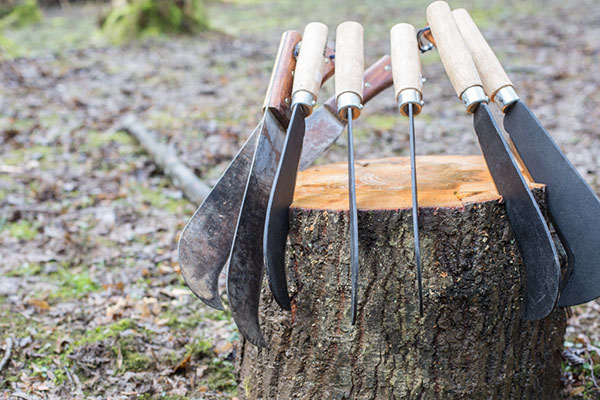
Cox uses an axe and a billhook to strip twigs from the rods. ‘I sort the rods according to what they will be used for, slice them to length and use a planer and band saw to cut them square before leaving them to dry for four to six months. Wood warps as it dries, so they’re planed again to get the flat, square-edged pieces we use to make furniture.
‘Then all I have to do is take this under-examined material and translate it into a language which makes sense to a modern consumer. That’s a fantastic brief. I steam bend the legs of the chairs. I split young hazel that’s too small to make anything else from and weave it for the seats. I’m learning to carve spoons from the curved, knotted sections, so I can use every last bit of the tree.’

This article was commissioned by the Telegraph and first appeared in the Telegraph Magazine on 05 July 2014. Photography by Adam Hollier.
Further reading for the especially geeky:
- feature :: bold as brass
- feature :: concrete; the quintessential hard stuff
- feature :: life through the lens of a lomo
- feature :: hand lettering