
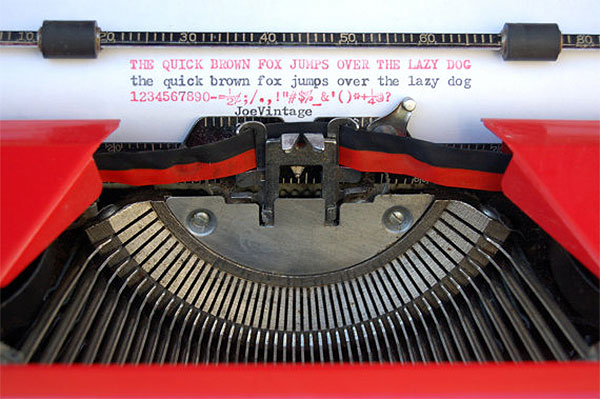

A search on etsy for “typewriter” returns 11,771 items from vintage typewriters to necklaces and cufflinks made from single letter keys – and everything from screen prints to cushions and stationery printed with iconic typewriter images.
What is it about old typewriters that appeal to us so much in this digital age? We’ve got MacBooks, iPhones and iPads (and products from companies other than Apple!), all of which far outperform the humble typewriter, so what’s the attraction?
Do we miss being able to see how things work; the sheer mechanics of an inked key imprinting clean white paper with a single letter? If that’s the case, it’s worth knowing that early typists (confusingly known as typewriters themselves) couldn’t see what they were typing, because you had to raise up the carriage to look; the words were typed on the bottom of the carriage.
Is it the familiarity of the shape and design of vintage typewriters that appeals? Perhaps. But look far enough back and they don’t look very familiar at all.
The very first typewriter only exists as patent for “An artificial machine or method for the impressing or transcribing of letters singly or progressively one after another, as in writing, whereby all writing whatever may be engrossed in paper or parchment so neat and exact as not to be distinguished from print” (and breathe!) filed by Henry Mill in 1714. Sadly he never got as far as making it.

The first typewriter to have actually worked was built in 1808 by Pellegrino Turri for his blind friend Countess Carolina Fantoni da Fivizzono. Many early attempts at typewriter design were to help blind people write. Turri also invented carbon paper. In 1829 William Austin Burt patented the “Typographer,” the precursor to the typewriter and then between 1829 and 1870 typewriter design was a flurry of patents that never made it to production. In 1856, The Cooper, a circular index typewriter, which used a revolving disk, was built and in 1861, Father Francisco João de Azevedo’s made a typewriter from basic tools and materials such as wood and knives. During this time Peter Mitterhofer made many models and finally a prototype in 1867, and in the same year John Pratt’s ‘Pterotype,’ was published in the Scientific American.
It took until 1870 for the first typewriter to go into commercial production. And it didn’t look anything like the ‘vintage typewriters’ we know and love. Danish pastor Malling Hansen’s “writing ball” was a metal sphere with letter keys all over it. The sphere moved until the right key comes into contact with the paper. Ingenious. But it looks more like a hedgehog than a typewriter.
It didn’t take long for Remington to get in on the act, beginning production of their first typewriter, the Sholes & Glidden in 1873 – and introducing the qwerty keyboard. Remington’s experience in building sewing machines might explain the foot pedal (for moving paper along) and decorative flowers that featured in their early models. They also produced guns, so we should probably be thankful they looked to their sewing machines for inspiration!

By 1901, the Underwood No. 5 model, which included a ribbon selector, a back spacer and a tabular was launched and went on to to sell millions, allowing Underwood to topple Remington as the top typewriter manufacturer in the world. Now, the No 5 looks like a typewriter. In fact it is lauded as the world’s most successful typewriter, and has certainly seen its fair share of screen-printed tea towels.
But besides providing charming graphics for home wares, what is the typewriter’s role in today’s society? Why does it have such enduring appeal? Will Self is reputed to write on one to this day – an Olivetti Lettera to be exact. And P.J. O’Rourke uses the IBM Selectric.
They follow in some pretty fine footsteps – Hunter S. Thompson used his IBM Selectric until the day he died – quite literally – his body was found sitting at it; the word “counselor” typed onto the page. Mark Twain was the first author to submit a typewritten manuscript – Tom Sawyer, produced on a Sholes & Glidden. Ernest Hemingway’s Royal Quiet de Luxe sold at auction for $2,750. George Orwell and Agatha Christie were both fans of the Remington Home Portable.
But Self and O’Rourke could opt for a MacBook, so why don’t they? (I own a rather fine Olivetti Valentine, but I work on a laptop.) For O’Rourke, it’s a case of avoiding the distractions that inevitably come with a computer’s easy access to the Internet. For Self, it’s a desire to construct prose in his head before he writes, rather than working it out on the screen.

And they’re not the only ones. There is such a demand for typewriters that they’re being upgraded into modern-day equipment by including a USB port, which will enable them to be connected to a computer, laptop or iPad and used as its keyboard. It seems people just can’t get enough of that clackety-clack sound. And many, many fonts exist to create the effect of the typewritten word on screen.
Another slightly more lateral adaptation is Tyree Callahan’s Chromatic Typewriter in which the letters and keys of a 1937 Underwood Standard typewriter have been replaced with colour pads and hue labels, creating a painting machine. A very structured approach to art perhaps, but with some surprisingly good results.
And there are plenty of collectors out there, keeping typewriters purely for their aesthetic, or for basic functionality. A blog called Typosphere provides a space for “bloggers who collect, use, and otherwise obsess over typewriters and other “obsolete” technologies. Life in a Typewriter Shop documents, well, life in a typewriter shop.

Further reading for the especially geeky:
This article first appeared in a different format in 91 Magazine in Summer 2012. With thanks to Joe Vintage for all images apart from my Olivetti Valentine (pictured with my portrait by Tobias Gutmann) – you can buy vintage typewriters from his etsy shop here.



Great feature. I’m jealous you have a Valentine typewriter! I did a feature for Disegno Daily on them recently and fell in love. I love the adverts they did with a red setter in them.
I haven’t seen those ads, but they sound fab! The Valentine is my pride and joy! I asked my other half for a vintage typewriter for Christmas thinking he’d pick me up a battered old thing in a charity shop and he surprised me with the Valentine! I’d only seen them in museums before, so it took me a little while to pluck up courage to actually use it! Thanks so much for taking the time to leave a comment xx
Just stumled across this blogpost, and it’s quite lovely. I own an Olivetti Typewriter myself, though mine is equipped with the extra letters in the Danish alphabet. It’s absolutely amazing, and like you mentioned, it’s my pride and joy as well.