
Ventura Lambrate is without doubt my favourite part of Milan Design Week. It is always bursting at the seams with young enthusiastic designers, new ideas and cutting edge design, with a real festival vibe – and this year was no exception. I spent a beautiful sunny day exploring every last corner.

Previously inspired by folded paper, RCA graduate Bartek Mejor created Polyp Aquatic Quartz by 3D CAD modelling of undersea coral reefs.

Patches by Beza Projekt come in seven variations allowing the user to combine construction elements at two angles – 90 degrees and 120 degrees, making DIY design projects deceptively simple.

Seats and Stripes by Bram Burger and Stijn van der Vleuten aka bram/stijn is designed to be flat packed and easy to assemble. “Made from no more than four components and two straps, it comes as a flatpack and sets up in a blink of an eye,” say the designers.

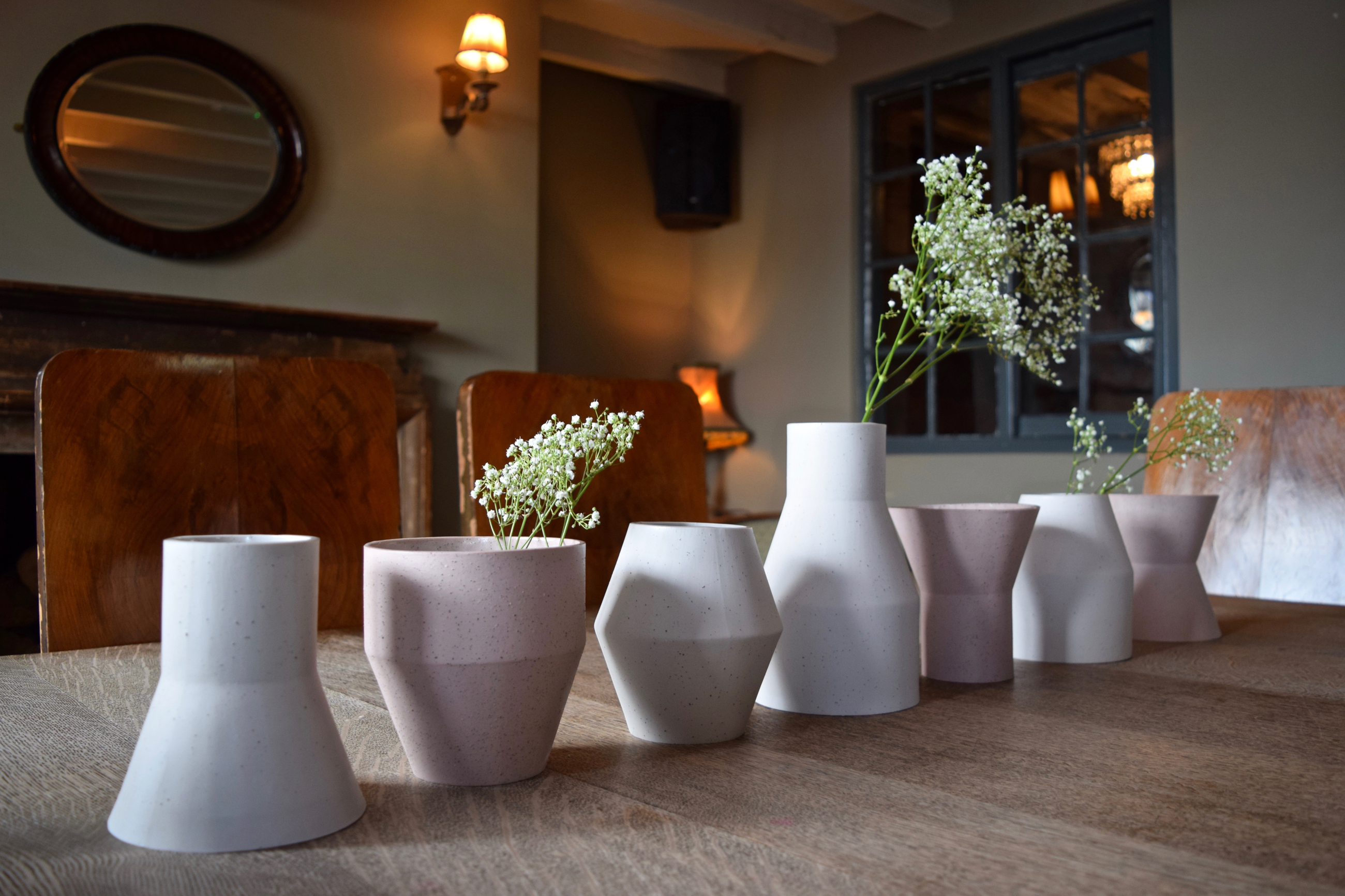
Design Academy Eindhoven graduate Tijmen Smeulders presented Pitcher, made of porcelain and available in Yellow-White, Grey-Grey and Blue-Antracite. I love their slightly anthropomorphic quality.

I work with Zoe Tynan-Campbell at LCC, so it was really exciting to see her skittles, part of the University of the Arts London stand. They have an irresistible folk art charm and no two are the same, so you can buy one or collect as many as you like.

As part of a celebration of the 100 year anniversary of acclaimed designer Hans J. Wegner, Void Chair by Simos Antoniadis and Ida Klarskov is derived from the curves of The Chair by Wegner and made from solid steel. The frame has been welded together to look like one continuous curve.

One of my favourite finds at Ventura Lambrate was Mass Produced Individualism by Iina Vuorivirta. Looking for something between handmade and industrially produced, Iina makes the ceramic form and then breaks it in half, creating a vase and a light shade.

Handblown glass was everywhere at Milan Design Week, and sometimes the simplest designs were the most effective. Van Eijk and Van der Lubbe collaborated with glassblowers from Guatemala, using local craft techniques and recycled glass for the expanded Cantel collection.

Steel Stand Table by German designer Sebastian Scherer is inspired by industrial-era architecture and made from ash or MDF with powder-coated steel legs in a variety of colors.

Elisa Strozyk‘s Ceramic Tables are made from cordierite, ceramic glazes and steel or copper. The surface of each table is created using traditional glazing techniques with a contemporary twist – different liquid glazes pool and merge as the tables are rotated and blown with air to leave traces of fluidity and smoke-like patterns which are then set in the kiln.

Rick Tegelaar says of his Meshmatics lamps, “I have developed a machine and a set of tools that enable me to form ‘chicken wire’ very accurately. By stretching the material over a mold it shrinks to the form taking its shape. The lamps are covered with a layer of bamboo paper. This paper expands when moistened because of its long fibres. When the paper dries over the mesh shapes, it wraps them tightly and contributes to the structure of the lamp. In this way two very simple materials work together very well. The bamboo paper diffuses the light and makes even the most terrible energy saving bulb pleasant to have around.”

Shinn Asano used to work in advertising and says, “I base my ideas on graphic design, regardless of the specific design category I’m dealing with. I feel it’s important to steer away from conventional thinking and always work from a clean slate when developing a project.” This collection includes the Kagome Stool, the Giogaia Chair, and the Hitotaba Lamp.

Designer and founder of Joine Office for Design Maarten Baptist wanted to create an environment where “anything could happen” and where he could release his own products because “some products should just exist”. The Julie range of decanters for oil, water and wine, is produced in the Czech Republic, Belgium and Portugal. They remind me of little birds.

Moai by Raul Frolla are terracotta vases, inspired by Easter Island’s stone statues, can be used both indoors and outdoors on balconies and city terraces. They were shown as part of the Incipit (‘the beginning’ in Latin) stand, a Milan-based creative lab and business whose aim is to nurture young talent, share skills and business acumen, and promote young designers.

Pot Purri by the 3 Dots Collective is a range of versatile concrete and metal forms that snap together with magnets to create lightshades, bowls and vases.

Thai Studio 248 presented The Cutting Edge Chair, inspired by the join between two materials: steel rod and teak wood. The steel rod is designed with voids, which lock the wooden structure in place, making the join more interesting by slicing the wood at an angle, drawing attention to the grain of the revealed surface.

The Honest Stool is designed to be free and open source so anybody can make one, using just one wooden board, a hammer and 24 nails. Plans are available to download from designer Cas Moor‘s website.

Another one of my top finds was Vein by Ben Storms. Not only is it a stunning dining table, but the underside is mirrored so you can prop it up against a wall (the legs detach and slot behind), giving it a second function.

And finally, I loved the colours and patterns in Wall Object by Sigrid Calon, part of the We Made This exhibition.
It was definitely my favourite day in Milan and I can’t wait to go back next year!

Further reading for the especially geeky:
- out and about :: wallpaper* handmade, milan 2014
- out and about :: milan 2014 preview
- out and about :: in the making (pt 2)
- out and about :: hello, my name is paul smith