
I have never made it to 19 Greek Street during London Design Festival before, so I was determined to fit it in this year, and I’m so glad I did. With the strapline “advancement, integrity and good taste” the Soho townhouse is painted entirely white inside, providing the perfect gallery backdrop for the often sculptural and concept-led design pieces. The Vino mirror by Iina Vuorivirta is angled in two different directions – to show the viewer’s face and their surroundings at the same time.

The U-stool by Hamajima Takuya uses sand-rock from his family’s back garden, and as well as being functional, seeks to “connect the individual with the world in harmonic relationship.”

Father & Son by Rasmus Baekkel Fex features one chair suspended in midair by virtue of being attached to its ‘father’.

“Widely used as a strong and resistant medium, mainly in the construction of buildings, concrete – as our choice of material – breaks with the conventional expectation of a material to be used in the crafts. The series explores what happens when concrete clashes with the scale of an object of craft, as opposed to a building. The vase is designed so that it thins out towards its edge. The broken edge stands in contrast to the fundamentals of object making, where the edge is required to be clear and perfect in order to define a shape. Confronting this perception, ‘Concretes’ sets before us a quintessential question: What is a whole object, and can the whole contain the imperfect at all?” says designer Noam Dover of the Concrete Vase.

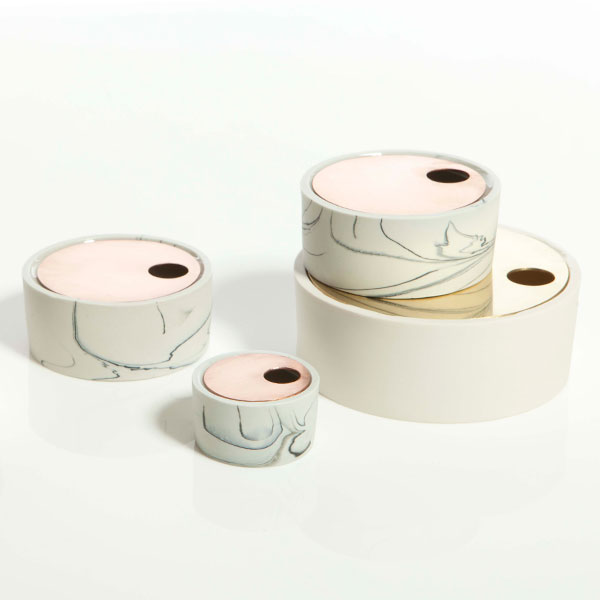
Another exploration of materiality in craft is Soft Pink by Christina Schou. The designer “shows reluctance to let her objects be defined as crafts in the conventional sense – they are manifestly not limited by restrictions, guidelines and ordinary, traditional regulations.”

In Junk Press Andrew Simpson, recycles paper collected from junk mail and transforms it, using a sand-cast aluminium press with a range of interchangeable moulds, into useful forms. Andrew is part of a design collection called Supercyclers, who use waste materials to create sustainable design.

The Pl(a)ywood Pyramid Stool by Ushki Studio was part of the collection displayed under the quote: “In nature, nothing is created, nothing is lost, everything changes” attributed to Antonine Lavoisier.

Ner Meiri’s Babilus Vases are made from stacked rings of bamboo, Corian, and chipboard with a glass insert – their varied heights and textures reference the architecture of ancient cities.

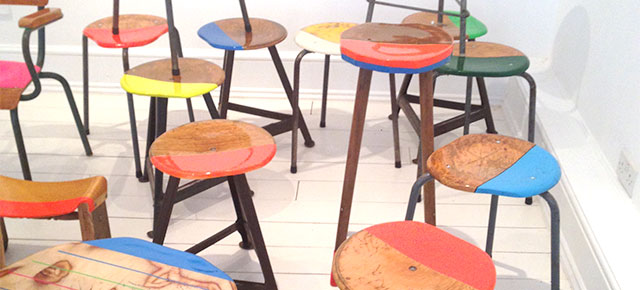
Finally, I absolutely loved Markus Friedrich Staab’s collection of chairs and stools. “The chair has been with us almost since the beginning of time. A piece of furniture not just for practical purposes, but as an expression of royalty, of religion, of hierarchy, of art. We examine the history of this unique object which has served each one of us since childhood,” said Markus. “Through my work I transform each chair into a unique and individual object. Chairs that once were mass-produced and homogenous, become singular and unique: re-cycled, re-furbished, re-mixed and redecorated.”
Don’t forget to follow live for the rest of this week on Instagram, Facebook, twitter and Pinterest.
Further reading for the especially geeky:
- out about :: LDF14 live
- out and about :: home london, LDF14
- out and about :: london design festival previews, LDF14
- out and about :: guide to the london design festival 2014