
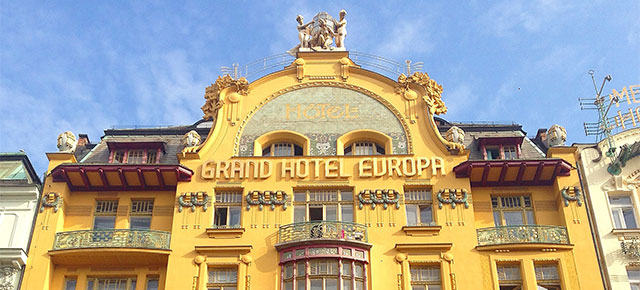

I have just got back from Designblok in Prague, which I was covering for Fiera Magazine, and will also be writing about in up-coming “out and about” posts here. In amongst the whirlwind of new design I did manage to squeeze in a little bit of time to explore the city…

Here’s a few of things I saw (from top to bottom, left to right):
- The Gothic Emauzy Church lost its spires as a result of an American air raid in 1945. A competition was held to design something to replace them and Frantisek Maria Cerny’s design for two interlinking concrete ‘wing towers’ was chosen. They have been described as ‘incongruous,’ but I think they work rather well.
- The Grand Café Orient is housed within the House of the Black Madonna designed by architect Josef Gočár, who was also responsible for the furniture and interior. Everything from the coat hooks to the cakes reflects his cubist aesthetic.
- While we’re on the subject of cakes, Café Dismas deserves a mention, not only for the great coffee, but also for the fact the café is run as a social enterprise, employing socially disadvantaged people, hence the strapline “Café without prejudice.”
- DOX is a little out of town, in the up-and-coming area of Holesovice, but as one of one Czech’s few independent art galleries, it’s worth the trek. As well as two exhibitions at any one time, there’s a design shop curated by Qubus and a café serving coffee and cake.
- Less well curated, but none-the-less featuring some interesting art and design, and worth the trip for the architecture alone, is Veletrzni Palace. It’s housed in a stunning functional building with a full height atrium at its core.
- But you needn’t look further than the graffiti in some parts of Prague for inspiration.
- The Leica Gallery is a quiet space with cool grey walls and pale wooden floors that provide the perfect backdrop to rotating exhibitions of contemporary photography. The book-lined café was empty when we visited, but seemed like it would have a nice vibe when busy.
- Precisely painted zebra stripes on wobbly old cobbled stones (literally “kitten’s heads” in Czech) seemed like the perfect analogy for the “old meets new” aesthetic of much of Prague’s architecture.
- Art book shop Kavka’s stunning curved glass frontage caught my eye. It sells art books from well-known publishing houses alongside titles published by art galleries and cultural institutions in Bohemia, Moravia and Slovakia.
- Frank Gehry’s collaboration with local architect Vlado Milunic was named the Dancing Building and nicknamed “Fred and Ginger.” Gehry claimed it was ‘pinched in at the waist” to preserve neighbours views, but critics complained he was just showing off.
- It’s perhaps a sad reflection of my obsession with stationery(!), but one of my highlights of the entire trip was definitely Papelote. The tiny shop was designed by A1 Architects, who stripped back the walls to reveal layers of plaster and covered the ceiling with gold wrapping paper. But far more exciting than that was the extensive range of affordable stationery including Pappelote’s own range and Czech-made Koh-i-nor pencils. Needless to say, I came out with armfuls of office supplies.
- Katr is a concept restaurant where diners can cook their own meat using the gas hobs embedded in their tables and the extractor fans above. Sadly when we were there, no-one seemed to be taking them up on this option, choosing instead to order meals cooked in the restaurant’s open kitchen.
- A piano left on a street corner to encourage passers by to play – we didn’t see this one in action, but did see some incredible jazz in a tiny basement venue called U Maleho Glena (Little Glen).
- And finally the canteen-style café at the National Museum New Building (the original building is currently closed for extensive renovations) is an open-plan light-filled space with chairs reclaimed from Prague’s trams.

Further reading for the especially geeky:


Really great Katie, as usual, and by the way you take very good photos. I think the church spires are sublime. Thanks for going on my behalf!