
Design Academy Eindhoven student Julian Jay Roux has taken a year out from his Industrial Design course to complete a one-year Contemporary Craft BA at Plymouth College of Art in the south west of England to explore the relationship and distinctions between design and craft.

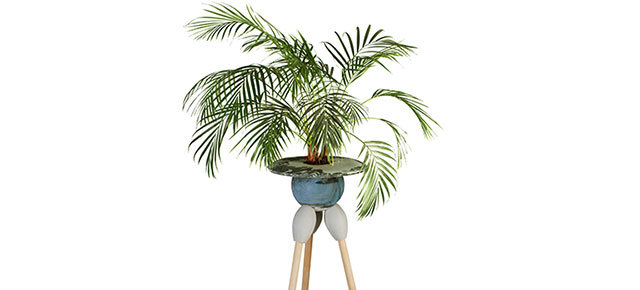
The designer’s graduate project, a collection of ceramic furniture comprising bulbous vases, seats and table tops each mounted on three wooden legs, is the result of a collaboration with a “purist” studio potter.

“I say ‘purist’, because in her practice she didn’t manipulate her work in any way once she had finished turning,” Julian told coadg. “Her work focused on forms she could throw from a single ball of clay, and mastering the techniques required to produce them.”

The two worked together first with Julian “deconstructing and then reconstructing” her thrown vessels and then learning to throw so they could reverse roles and she could manipulate his work.

“Through this dialogue of approaches I learned that studio potters have a vocabulary of techniques with which they construct various forms; slender vase shapes, bottle-forms, bowls, plates, spouts, handles, necks, feet…” said the designer. “I looked at these forms as modular parts with which to make an assembly and came up with a scale prototype for a ceramic stool.”

The prototype, which Julian describes as “an egg-form with three spouts coming off it,” was used to commission a slip-cast 1-1 prototype made from unglazed high grit Raku clay, to investigate the feasibility of a ceramic stool. Having decided it was strong enough, the designer then worked with other modular elements to add tables and plant-pots to complete the collection.

Reflecting on this project, and the break from his studies in Eindhoven, Julian said, “I have moved from being a designer of ‘things’ towards being a designer of social and material production processes that produce ‘things’. I have come to see that the classical top-down design process; of conceiving a thing in the abstract and then producing that thing, is often brutal in the sense that the design process usually doesn’t consider the environmental and social context and consequences of producing that thing.” He contrasts this approach with what he describes as the “ground-up” craft process, where a designer starts with a raw material and a deeper understanding of the social and ecological consequences of production.

“I am incredibly grateful for everything I learned at Plymouth College of Art”, he said. “I will carry it into my final year at Design Academy Eindhoven, and beyond into my future practice.” Julian’s collection was showcased as part of Plymouth College of Art’s stand at Tent London during the London Design Festival in September.

Further reading for the especially geeky: