
This is the final essay in a series of four about the behind the scenes process leading up to the installation of The Invisible Store of Happiness in Saint John’s Arch during Clerkenwell Design Week. This one is entitled Informing and was published just before the grand unveiling.
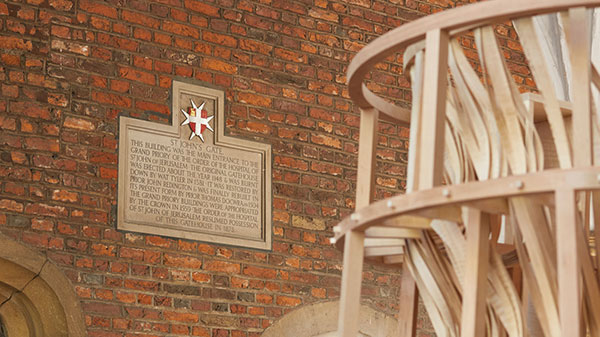
On 19 May 2015, the Invisible Store of Happiness by Sebastian Cox and Laura Ellen Bacon will be installed in the archway of Order of Saint John in Clerkenwell, and after months of thinking, designing and making, the project will be complete.
But in some ways, this is just the beginning. The role of the installation, in the words of AHEC’s marketing director David Venables, is to “inform the debate,” which for David is more about provoking questions than providing answers. “It should make people think: ‘How did they do that?’ or ‘What on earth is this?,'” he said. “I love it because I can already hear all these questions: ‘How long is it going to be here?’ ‘What sort of wood is that?’ and ‘Who made this?'”
“I don’t think my job is to make people buy more American hardwood,” he said. “I think my job is to create an environment where people are choosing to use American hardwood because of a better understanding of the materials.” That understanding encompasses everything from craftsmanship to environmental concerns.
“One of the debates we’re addressing is about the seriousness of craftsmanship and what happens when you put two amazing craftspeople together,” he said. “Our job was to pick the right people, put our trust in them and let the process happen. Creating is about relationships and every time we do one of these projects, we learn more about that collaborative process. I think that’s very valuable.”
The other element of craftsmanship was about pushing the boundaries of what is technically possible with wood. “Sebastian and Laura were continuously improvising,” said David. “It’s been an on-going experiment. One of the challenges for wood right now is embracing innovation and we’re learning all the time. We could write a manual on steam-bending hardwood as an outcome of this project.”
The two designers have been sharing their learnings throughout the process, not just with AHEC, but with a team of interns and students. There’s a type of insight you can only gain by doing something yourself – a ‘hand’ understanding rather than a ‘head’ understanding, and it’s one Sebastian and Laura are keen to share with whoever is interested enough to lend a hand.
And finally, there’s the environmental impact, which is where American hardwood really comes up trumps. “I’m a marketing guy so I look for advantages,” said David. “We’ve got some brilliant timbers that you can make efficient structures out of, that you know are affordable and there in the long term.” The hardwood forests in America are so vast that the wood used in the Invisible Store of Happiness will have been replaced in the time it takes to walk from one end to the other. The whole project has undergone a formal process of environmental Life Cycle Assessment (LCA) and the carbon footprint of the whole structure, on a cradle to grave basis, is just 173kg CO2 equivalent – that’s less than an iPad Air 2.
“When we started this project, I had no idea quite what we would end up with,” said David. “But I knew one thing for sure, when we got in under that arch, it would create a buzz. People are going to want to touch it, regardless of whether they love it, hate it or simply don’t understand it. Emotion is good, positive or negative, because it means people are thinking about it, and that’s all I want them to do: If people are thinking about what we’ve done then this thing has immense value.”
Further reading for the especially geeky:
- feature :: the thinking behind the invisible store of happiness
- feature :: designing the invisible store of happiness
- out and about :: ambiente frankfurt
- out and about :: greenhouse, sff15