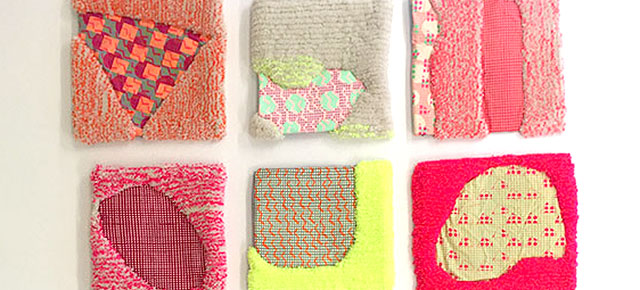

Graduate show season has drawn to a close, so I thought I’d share some of the most inspiring projects I’ve seen this year. I visited Plymouth College of Art (where I spotted, among other things, Melanie Wood’s neon carpet concept above), the Royal College of Art, Central Saint Martin’s, New Designers and New Designers One Year On in search of work that challenges conventions, solved meaningful problems in elegant ways, or just made me smile. This is what I found…

From top to bottom, left to right:
- Plymouth-based furniture designer Samantha Walpole‘s Hexagon Side Tables are available in a wide range of powder-coated colours, but it was this yellow one that caught my eye.
- Design Academy Eindhoven and Plymouth College of Art student, Julian Jay Roux, has designed this series of side tables and planters.
- I loved Jenny Jefferies’ contemporary take on traditional garden furniture – adding a breath of summer air to a pretty rainy day.
- Twin sisters and RCA graduates Begum and Bike Ayaskan have designed these ingenious plant pots that use an origami-based structure to enable them to expand as the plant grows.
- Balanced Reading by Greek designer Alexandra Voulpioti ensures the books we haven’t read are kept in balance with the ones we have.”The worst thing that someone can do to a book is to never read it,” she says.
- Bottle Buoy by University of Huddersfield graduate James Benson is a 70p buoyancy aid made from recycling soft drinks bottles, is designed to help young children in developing nations learn to swim, to help prevent some of the 372,000 annual deaths from drowning, 80{ff546b69e23b1524d799f96c6ba7a638e1f677053b0a2a1568b05315fd5f8fc7} of which occur in low to middle income countries. James won the New Designers Mars Award in recognition of his work, which the judges described as “a lifesaving response to a real problem, which has been designed in an elegant way and made accessible to the people who need it.”
- William Yates Johnson‘s Polyspolia project is a proposal for a production system of domestic objects in which an item, if it breaks or loses favour with its owner, can be broken up and remade into a new and different piece – the broken pieces are visible in the new piece and made a feature of, rather than disguised.
- One of the most striking pieces I saw was Swansea Metropolitan University graduate Llinos Mai Bolton‘s Foxii – an alternative oxygen inhaler, that uses new technology to avoid users having to carry a heavy oxygen tank, and takes its visual cues from the fashion world rather than medicine, to promote a positive body image and reduce stigma for young women with respiratory problems.
- RCA graduate Sehun Oh aims to design objects that are “useful, beautiful and meaningful.” His Plumb system of modular furniture is made from a series of 3D printed plastic connectors and off-the-shelf wooden dowels that people can buy themselves to create anything from chairs to shelving units.
- Hedgehog numbers have declined in the UK from over 30 million in the 1950s to just 1 million today, such that they are now an endangered species which could be extinct by 2020 – that’s just five years from now. Hoglodge is Kingston University graduate Antigone Frichot’s solution – a safe shelter for hibernating hedgehogs and a resting spot for sleeping and rearing hoglets in the spring and summer months.”Finding out about the struggle a much-loved species such as the hedgehog faces to survive made me determined to do something practical that might be able to help its plight,” said the designer.
- On a lighter note, Thor ter Kulve and Robert McIntyre’s CanopyStair is made from curved birch plywood platforms, which are bound to a tree trunk with adjustable straps to create a staircase enabling users to climb the tree. It’s been designed to be used without harming the tree.
- Daniel Durnin‘s Waterbed celebrates “the luxury of simplicity” and is conceived as a way to escape the pressures of the urban landscape and reconnect with nature using the existing waterways within and beyond the urban environment.
- I loved the simplicity of Brisol-based designer Rebecca Ayling’s ceramics collection.
- University of Dundee graduate Sam Holdworth added Scandi style to mobility aids to create Förmå. “A cold, medical aesthetic dominates many mobility aids intended for home use — basic functionality and low cost tend to take precedence over form or how the devices will make users feel,” said the designer. “Förmå makes use of tactile materials and a sympathetic furniture-inspired design language to challenge perceptions of mobility aids and provide users with practical devices which they will be happy to use, and welcome into the more personal spaces of their home.”
- I’ve mentioned Wael Seaiby‘s Plag vessels before when I spotted them at May Design Series, but I couldn’t leave them out of this round-up. They are made from plastic bags and absolutely gorgeous.
- Central Saint Martin’s graduate C. Novella’s Mobile Industrious Unit was designed to get around the restrictions on social housing residents working or setting up businesses from home. It can be used as both a workspace and somewhere to exhibit and sell work and ideas.
- Tempo is by another CSM graduate, Marcus Kane, and is a self-powered wall light providing 15 minutes of light. Pulling down the light’s pendant raises a weight on the other side. As the weight falls, the light is turned on until it reaches the bottom again, changing the quality of light as it does so. The intention is to engage people with their lighting and reduce energy consumption.
- I loved Hannah Wollard’s reinterpretation of the traditional tea-set.
- The second appearance from William Yates Johnson is for his CMY glasses – the cyan, magenta and yellow glasses combine by placing one inside another to make red, green and blue. I absolutely love them.
- University of Brighton graduate Ellie Birkhead created a series of beechwood and hog bristle brushes with unusual shapes each designed to clean a very specific object.
- Robyn Hinchcliffe is a London-based textile product designer specialising in knitted textiles for the home – I absolutely loved her fabrics and cushions.
- And last but not least, Ted Wiles’ Involuntary Pleasures collection comprises household objects that require users to interact with them in a way that promotes wellbeing, for example a toaster that only works when it is hugged, releasing endorphins and dopamine, and an alarm clock that buzzes until the users holds it above their head in the so-called “victory position”, proven to increase confidence and reduce stress.
Further reading for the especially geeky:
- out and about :: the fiera edit
- out and about :: stockholm
- out and about :: twelve at stockholm furniture fair 2015
- out and about :: ambiente frankfurt