
Following the success of the first #designbookclub (you can read the full transcript here), we’ll be getting together again at 9pm GMT (4pm EST) on Thursday 04 February to discuss The Craftsman by Richard Sennett. It’s an absolutely wonderful book – one of those that ends up with a cracked spine, folded down corners and underlined paragraphs, even if you’re usually someone who likes to keep books pristine.

In the book, Richard explores the idea of craftsmanship in its traditional sense, but also craftsmanship as “the desire to do a job well for its own sake – as a template for living,” giving it a much wider relevance. As the book jacket says, “the values of the craftsman…can enrich our lives and change the way we anchor ourselves in the world around us.”

In Chapter 4 Machines, Sennett shares Ruskin’s Seven Lamps of Architecture, which include “the lamp of sacrifice – the willingness to do something well for its own sake,” “the lamp of truth – Ruskin’s embrace of difficulty, resistance and ambiguity,” and “the lamp of obedience – strive to be like Stradivari, but do not seek to copy his particular violins.” There are certainly lessons there that apply outside of architecture.

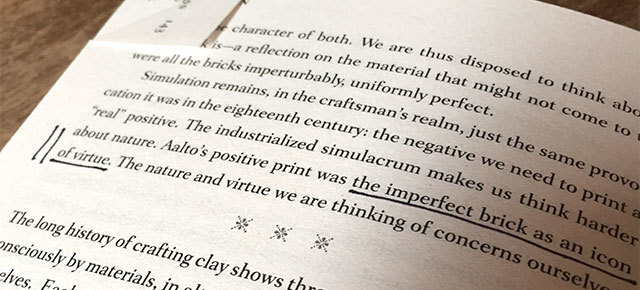
Despite the fact it was published in 2008, a lot of its themes seem incredibly ‘of the moment’ – or perhaps they just address timeless debates. I explored the ‘trend’ towards embracing perfection – and the dangers of taking it too far and mimicking imperfection – in Issue 02 of Fiera in an opinion piece entitled Future Perfect. In Chapter 4 Material Consciousness Sennett talks about the debate that raged around the homogeneity achieved in bricks through the introduction of the Hoffman Kiln in 1858, and the pre-industrial brick-makers faking age with pig slime! A wonderful example is Alvar Aalto’s Baker House built 1946 – 1949. Sennett quotes Aalto’s “self-consciously primitive” method of making and using bricks: “The bricks were made of clay from topsoil exposed to the sun. They were fired in manually stacked pyramids, using nothing but oak for fuel. When the walls were erected all bricks were approved without sorting, with the result that the colour shifts from black to canary yellow, though the predominant shade is red.” Sennett suggests this is the debate coming full circle, but I would argue that it’s still going!

The final paragraph of the final chapter Conclusion is entitled Ethics: Pride in One’s Work. “I’ve left for the very end of this book the subject the readers may well think should have come first,” he writes. “Pride in one’s work lies at the heart of craftsmanship as the reward for skill and commitment. He ends on Hephaestus, the Greek God credited in Homer’s Iliad with building all the houses on Mount Olympus, as well as being a coppersmith, a jeweller, and the inventor of chariots, but who is lame, a source of deep shame in ancient Greek culture, saying “The clubfooted Hephaestus, proud of his work if not of himself, is the most dignified person we can become.”

Join us on twitter via the hashtag #designbookclub at 9pm on Thursday 04 February to discuss this inspiring book – and make a note of the next two book clubs too: we’ll be discussing Design Like You Give a Damn by Cameron Sinclair at 9pm (4pm EST) on Thursday 03 March, and The Art of Looking Sideways at 9pm GMT (4pm EST) on Thursday 07 April.