
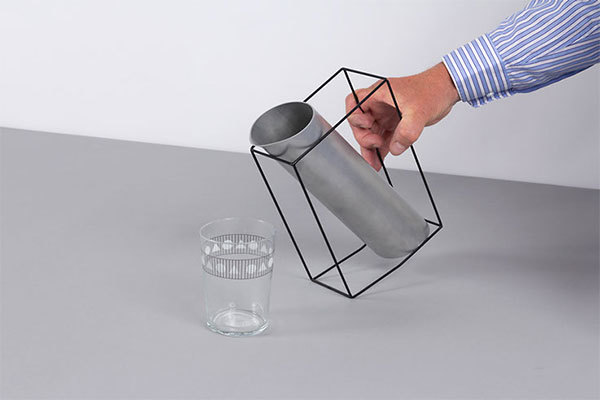

This is the latest in a series of interviews with designers identified by the Design Council as Ones to Watch. Simon Kinneir’s Leaven collection of kitchen products has been designed with subtle tweaks from their ordinary counterparts to give extra sensory feedback beyond a reliance on sight – these changes improve the practicality and enjoyability of a task. Through touch, temperature, sound, or movement, these products amplify active processes in the task at hand. For people with sight-loss, this means increased confidence in the kitchen which translates into improved self-sufficiency. His ‘kitchen anchor’ concept supports peeling, grating and chopping, aiming to improve joint health. Simon’s project was selected in the Healthier and happier category alongside Sebastian Nause-Blueml’s Lift – service design that makes the jobs of carers more motivating and engaging and Matthew Cardell-Williams’ MyMed – a concept that helps with medication management for older people.

What’s the most important thing to know about you?
Alongside my current work with Arthritis Research UK, I am interested in working around sight-loss and in streamlining understanding ‘disability’ for designers. Before studying Design Products at the RCA, I had a background in graphic and spatial design.

What inspires your work?
People’s intuitive adaptive behaviour to context or condition, design being a unique, powerful opportunity or tool.

Talk me through your design and making process.
Understanding a person’s personal perspective: their perceptions, engagement, intentions, priorities, feelings, everyday life, routine, context, moments of adaptation or moments for design, the people around them – variations of external and immediate factors. I follow the ‘double-diamond’ stages of design research – a model developed by the Design Council that comprises ‘discover’ –identify, research and understand the initial problem; ‘define’ – limit and define a clear problem to be solved; ‘develop’ – focus on and develop a solution; ‘deliver’ – test and evaluate, ready the concept for production and launch.
What’s your favourite part of the process?
Interviewing through an activity, making: it is such a luxury.

What’s your favourite tool and why?
InDesign and siblings: we have known each other a long time .
Tell me about a really good day and a really bad day in the life of Simon Kinneir.
On a good day, I collaborate with a participant or colleague and we make some great steps forward. The sun is up. Jackpot. Currently, I am developing The Kitchen Anchor; a non-slip chopping board that locks bespoke utensils (e.g. a grater) in a stationary position.

What defines good design?
Intuitive to use, long-term benefit, aesthetic, and a resourceful production cycle – and ‘comfortable’ – would you be happy to have and use this design at home and outside?
What are you most proud of?
Friends’ work. The Jug and other attempts to work with inherent subtle sensory feedback.

What advice would you give to an aspiring designer?
Commit, test it, ask early, don’t make assumptions.

What did it mean to you to be selected as one of the Design Council’s Ones To Watch?
The Design Council has selected a broad range of people who employ their energy and specialism to the benefit of other people. It is really exciting and reassuring to be part of that.
And finally, what’s your favourite colour?
Let’s say yellow.

Further reading for the especially geeky:
- interview :: made by michael
- interview :: nordvink
- interview :: james molkenthin
- interview :: juliette bigley

I really love his designing, thanks for the interview!
Important work really nicely executed and inspiring!